GOLDEN JUBILEE 1888 – 1938
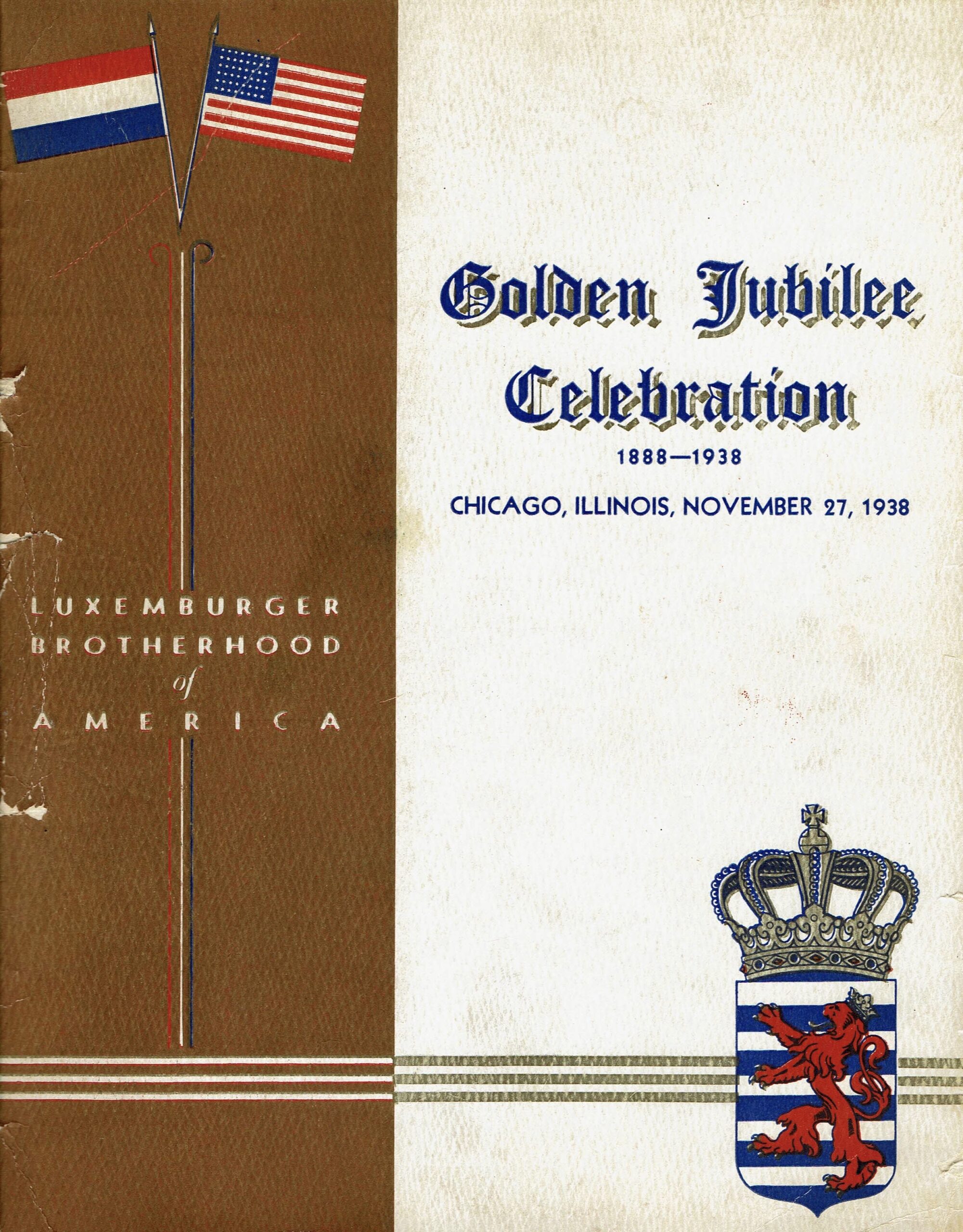
GOLDEN JUBILEE CELEBRATION
CHICAGO, ILLINOIS, NOVEMBER 27, 1938
The following is a Digital Transcription of the GOLDEN JUBILEE CELEBRATION BOOKLET that took place in November, 1938.
THE LUXEMBURGER BROTHERHOOD OF AMERICA 1938
Historical and Pictorial Review
Compiled by Fred A. Gilson, Grand President
Research and Dedication
To write the historical reminiscences of the Luxembourg Brotherhood of America and its subordinate Sections requires considerable research work. However, I am very grateful to the former leaders of the Brotherhood as well as the former literary talented members of the various Sections for the historical facts and data that they compiled and preserved for future generations in former Souvenir Program Books and Schobermesse Program Books. These books have a great historical value and should be preserved by the Luxembourg people for their descendants. I also hope that the members will find a suitable place for this Souvenir Program Book in their libraries and preserve it for their descendants.
I am dedicating this historical review, which I herewith present to the Luxembourger people, to these former leaders and historians of the Luxembourg Brotherhood of America. Foremost among these leaders, whose memory still lingers with gratitude in our minds and whose writings form our background, are:
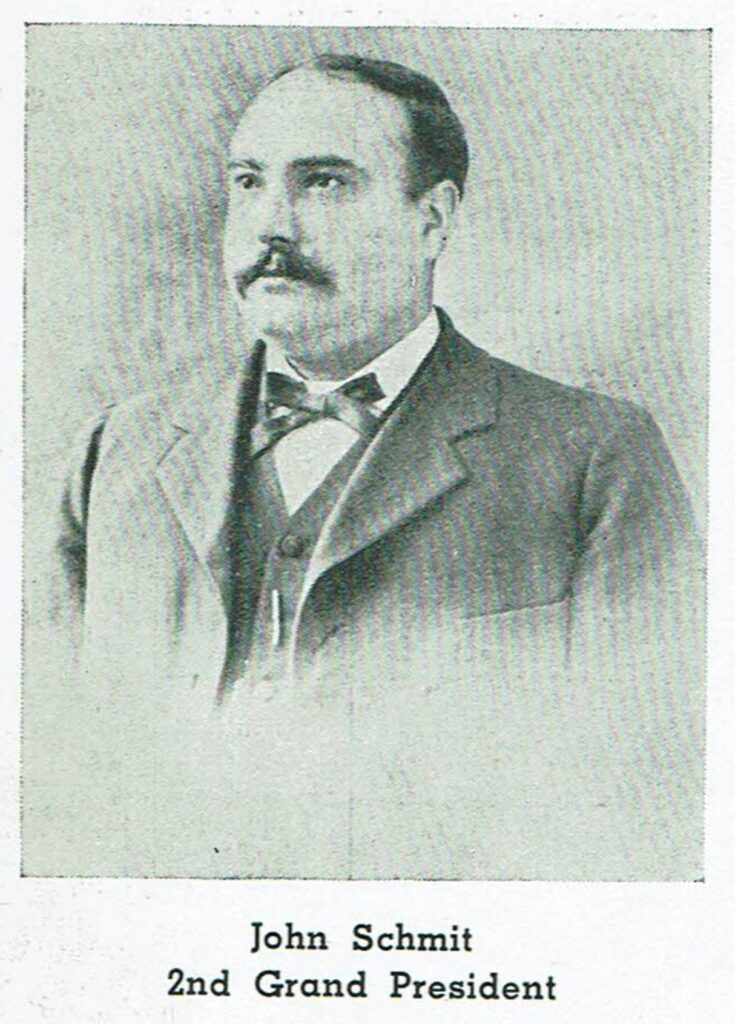
| John Hankes | Mathias Huss | John Watry | John Diederich |
| John Schmit | Peter Weiland | Henry Geimer | Henry Dieschbourg |
| Eugene Bellar | John Weiland |
Others, who have the privilege to assist in the celebration of the Golden Jubilee, are Nick Nilles, Joseph Winandy, J. P Knaff, J. B. Merkels and perhaps your humble writer. Many others have rendered valuable services to the Luxembourg Brotherhood of America and to the Luxembourg people, and these will be remembered in subsequent pages and in the history of the various Sections, which will be annexed to this historical review of the Luxembourg Brotherhood of America.
It may be only a coincidence that this Golden Jubilee Celebration falls so close to Thanksgiving Day, but it surely gives added reasons for us to be thankful, and it should inspire the heart of every Luxembourger to a prayer of thanks, in memory of the pioneers who had the wisdom and the spirit of fraternity, of brotherly love and devotion to organize the Luxembourg Brotherhood of America. It required courage, sacrifice, determination and goodwill, not only to start it, but also to preserve it and expand it to the mighty organization as we know it today. I venture to say that the organizers did not dream that someday their “Bruderbund” would grow into the largest “Luxembourg” fraternal organization in the world.
Motive for Organization
The motives to organize a Luxembourg Brotherhood were manifold, and the events leading to its final organization were diversified. The nature and instinct of the Luxembourgers coming as settlers to the United States of America from 1850 to 1875 was not society-minded, since fraternal societies were unknown in Luxembourg until the close of the 18th century. Although there were in Luxembourg many music bands and Singing Societies and perhaps a few agricultural organizations, insurance and sick benefit societies were not in existence.
However, the mode of living in the United States, the cosmopolitan aspect of the new country, brought about a feeling of fraternal inspiration, a feeling of brotherly and neighborly love into the hearts of the early Luxembourg pioneers toward each other. His new field of activity, his problem of establishing a home for himself and his family among strangers in a strange land and among people from all parts of the world, made the contacts he made at various intervals with his fellow countrymen from Luxembourg an event of great joy and happiness.
These looked-for and anticipated gatherings, generally on Sundays or holidays at the home of some countryman, were utilized to cultivate an intimate friendship and foster the Luxembourg language as well as Luxembourg ideals and traditions. As the immigration from Luxembourg grew, especially from the year 1875 to 1900, these friendship gatherings became more frequent, especially in parts of the country where Luxembourg centers of settlement had developed, such places as Chicago, New York, Port Washington, Dubuque, Remsen, Escanaba, etc., etc.
And so, the idea of forming a Luxembourg society became apparent, as the desire for frequent, mutual gatherings increased through the pleasure that was derived from the conversations in Luxembourg and on reminiscences of childhood days, as well as the joy in again speaking the Luxembourg language.
Early Luxembourg Societies
The 1st Luxembourg Society was organized in Williamsburg, N.Y., and had for its leaders such men as Nick Mueller, who was at one time a Representative in Congress in Washington, D. C., J. M. Blum, Ernest Derulle, Emile and Alphonse Fritsch, Eugene Bellar and others. Soon thereafter, in the year 1870, a Luxembourg Society was organized in Chicago; namely, the Luxembourger Unterstuetzungs Verein.
Its first officers were:
| President | J. P. Lauth |
| Vice-President | P. Bernard |
| Secretary | J. Kartheiser |
| Treasurer | Henry Birren |
This society made very good progress, but in the 2nd year of its existence, the great Chicago Fire of 1871 caused the loss of most of the worldly goods of its members and brought about a period of difficulties, complications, and hardships, which were arduous and perplexing. However, as is often the case, the greater the difficulties, the greater the efforts and determination; and so, it was with this Unterstuetzungs Verein. It soon recovered, prospered, and in the year 1877 it had 57 members, with a treasury fund of $1,250.00. The society was legally incorporated as a benefit society, paying $300.00 death benefit on the death of a member and $200.00 death benefit on the death of the wife of a member.
The yearly dues were $6.00 with an assessment of $1.00 on the death of a member and Fifty Cents on the death of the wife of a member. Under the leadership of Peter Reiter, who was president for many years, great success was achieved. For social as well as for financial reasons, a yearly Ball (Dance) was held in Mueller’s Hall on North Ave., as well as a yearly picnic. Both of these events became very popular and were the two great attractions for the Luxembourg people and their friends.
Unfortunately, the financial basis of this benefit society was not sound; insurance mortality tables experience had not as yet been developed and established for a basis of sound insurance facts and figures. In a short time, as the death ratio increased with each year, the reserve benefit fund dwindled and finally came to an end with a dissolution of the society.
In the meantime, other Luxembourg benefit societies had been established in St. Paul, Minnesota; Dubuque, Iowa, which prospered for a number of years but never developed into a real sound and successful Benefit and Insurance Organization.
In the year 1887, the Luxembourg Independent Club was organized, having as its basis and object political and social motives. It was composed of men from all parts of Chicago and its suburbs, but mostly from the north and the south side of the city. This Club has been successful and is still in existence today. However, out of a dispute which arose in one of its meetings, due to differences in the conservative faction and the more liberal faction, the seed of the now “Luxembourg Brotherhood of America” was planted. Parliamentary rules and meeting procedures were new to many members in the Club, and strict adherence to rules and order by the then leaders was often the cause of ill-feelings, disappointments, and disagreements.
After a stormy meeting held in the fall of 1887, during which the liberal faction was defeated in its proposals, a “Rendezvous” was held in the tavern of John Hankes, located on Halsted St., near Archer Ave., for the discussion of their grievances. Present at this gathering were: Michael Unsen, Nick Stirn, Bernard Dieschbourg, John Schmit, Bernard Monitor, Nick Mersch and Charles Puetz.
In the midst of their discussion, Nick. Mersch suggested they organize another Club for the Luxembourgers living on the south side of Chicago. All present agreed to this idea, and John Hankes donated $1.50 to buy postal cards to call a meeting of the Luxembourgers living on the south side for the formation of this new Club. Nick. Mersch issued the invitation, and on October 23rd, 1887, the organization meeting was held with John Schmit presiding.
The Club was duly organized on that day, and the following officers were elected to guide the destinies of the new “Luxembourg Club” for the balance of that year:
| President | John Schmit |
| Vice-President | Nick Stirn |
| Secretary | Nick Mersch |
| Treasurer | Michael Unsen |
Present at the meeting were 25 men, who joined the Club by paying an initial fee of 25 Cents: thereby making a treasury fund of $6.25. A committee consisting of Bernard Dieschbourg, John Diederich and John Hankes was appointed to draft a constitution, and orders were issued to announce the formation of the new Club in the “Staatszeitung” and in the “Arbeiterzeitung”, newspapers, which were flourishing in those days.
The next meeting was held on November 6th, 1887. At this meeting, additional time was granted to the Constitution Committee with the appointment of three more members to the committee, namely, Nick Cigrang, Edward Turmes and John Schmit. At the 3rd meeting held on Christmas Day, December 25th, 1887, the Constitution Committee presented its Constitution, which was compiled by John Diederich along similar lines as the Constitution of the “McCormick Reaper Works Benefit Society”; and which gave the new Society or Club its official name, “LuxembourgBruderbund”.
After the adoption of the Constitution by the assembled members, the following first set of officers were elected:
| President | John Diederich |
| Vice-President | John Schmit |
| Rec. Secretary | Nick Mersch |
| Financial Secretary | Nick Cigrang |
| Treasurer | Bernard Dieschbourg |
| Trustees | Nick Stirn, John Hankes & Peter Hubing |
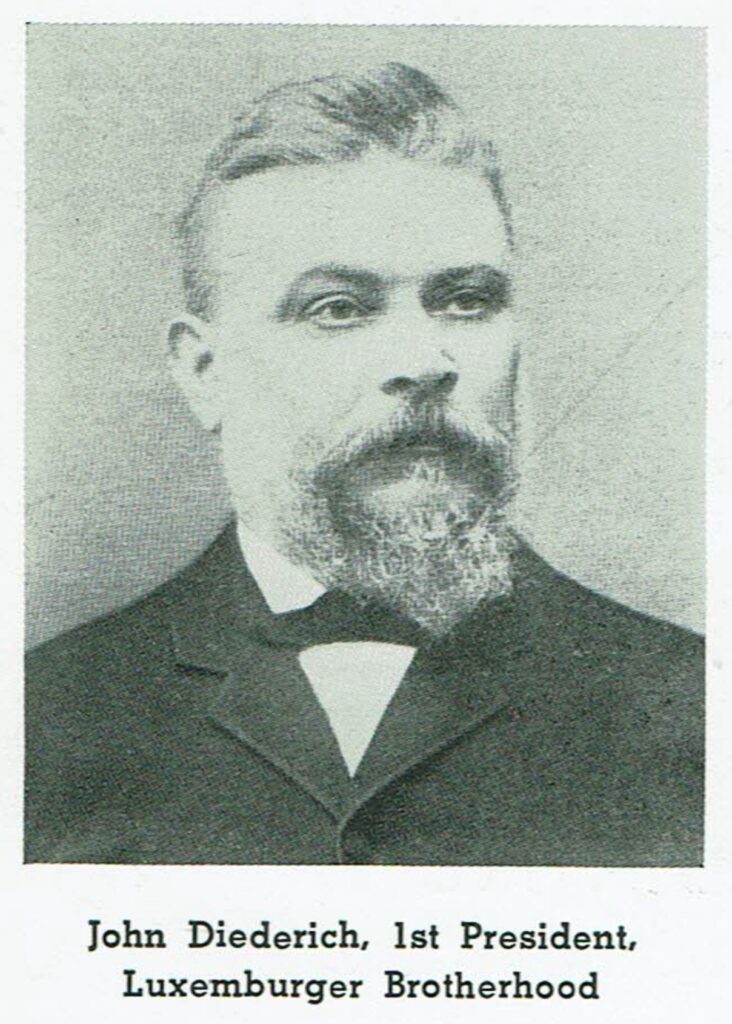
The 1st social function held by the Luxembourg Bruderbund was a dance held in the early part of January 1888.
A few days thereafter, in the January meeting of 1888, the newly elected officers were duly installed in office. The report in that meeting of the dance committee showed a profit of $36.25, and this amount with the dues collected at the meeting gave the treasurer a fund of $103.45. After the next meeting held in February 1888, we find the following members on the roster list:
| John Diederich | Michael Unsen | Nick Stirn | Nick Cigrang |
| Valentine Hankes | Nick Mersch | John Schmit | Edward Turmes |
| Henry Feiereisen | Bernard Dieschbourg | J. B. Erpelding | Nick Feiereisen |
| W. Paultz | John Schaak | Nickolas Weber | Math. Schils |
| H. E. Stirn | John Schimberg | Nick Bonert | Peter Lenz |
| Henry Schmalen | Nick Hansen | Gustave Witwer | Jacob Alken |
| Nickolas Habig | J. P. Mootz | John Hankes | Peter Hubing |
In the March meeting of 1888, a committee was appointed to contact the Luxembourg Independent Club for the purpose of running a joint picnic. This proposal was denied by the Club, which stated that it would have nothing to do with the Luxembourg Bruderbund. This refusal encouraged the members and, on their own initiative, sponsored an excursion to Cedar Lake, Ind., which was a grand success. and added an additional amount of $114.35 to the treasury.
Many of the conservative elements of the Independent Club ridiculed the new Luxembourg organization, calling it many names; and thereby jeopardized the work of its officers and members. No one suspected at that time that someday, this society would be so successful and become the now-known “Luxembourg Brotherhood of America.”
In the fall of the year 1888, the Bruderbund had grown very satisfactorily, and a good future was in the offing. It was then decided to legally incorporate the “Bruderbund” as a Sick and Death Benefit Organization in the State of Illinois, and on December 8th, 1888, a State Charter was granted and issued to the “Luxembourg Bruderbund.”
The following additional members besides the ones named above were noted on the Charter Page of the records:
| W. Spanier | Bernard Molitor | Nick Manderscheid | Peter Girten |
| Charles Puetz | Jacques Hilger | Nick Ludwig | Anton Wark |
| Nickolas Michels | Jacob Mathey | Nick Wagner | Math Toekes |
| Peter Scholler | J. M. Lauf | George Trierweiler | Michael Lorang |
| Henry Reiff | Thos. Wagner |
From 1888 to 1896, steady progress was made by the new Luxembourg Bruderbund in its new sphere of activities. During this period the following members had acted as presidents: Nick Stir, Nick Weber, Henry Feiereisen, John Schmit, Peter Scholler and John Hankes. All of these men were imbued with the spirit of real brotherly love and worked hard to build up and expand the activities of the society. The results of their efforts were very gratifying, a moral and social, as well as financial success. The good name of the society soon spread into other States, where Luxembourg settlements had been made, and soon similar societies with the same name were established in St. Paul, Minn., and Esdanaba, Mich.
First Luxembourg Congress
During the year of 1893, the World Fair year of Chicago, when many world congresses were held in the City of Chicago, the Luxembourgers expressed the desire to hold a Luxembourg Congress in Chicago. On an appeal issued by the Luxembourg Independent Club, a Luxembourg Congress was held on October 22nd, 1893, in Brand’s Hall in Chicago. Delegates present were from Dubuque, Iowa; Winona, St. Paul, Shakopee, Minnesota; La Crosse & Milwaukee, Wis.; Detroit, Michigan, and Aurora, Illinois, among them several priests. John Ludwig of Winona, Minnesota, was selected as the presiding chairman, and Nick Gonner of Dubuque, Iowa, was selected as the secretary.
The topic on the order of the Congress was how to promote the interests of the Luxembourg people living in the United States of America in the best possible manner. The main object of the discussions was to preserve the ideals, the characteristics and the traits of the Luxembourg people, to transplant them into the American civilization and to preserve the Luxembourg language and keep aflame the love for the old Fatherland.
During the consideration of the problems before the Congress, it appeared as if a Central Luxembourg Organization, similar to the Catholic Central Society of America (Deutsch Katholischer Central Verein von Amerika), would be best suited for the attainment of their objects.
It came to light also that in as much as the movement to establish a Luxembourg Consulate in America had proved futile, such an organization might even assume the duties of a Consulate and in this manner be of service to the Luxembourg people; especially to immigrants, who came in large numbers from Luxembourg during those years and established themselves in the new country. Another committee on benefit and insurance features promoted the idea of sick benefit and life insurance, similar to the Minnesota Catholic Benefit Organization, which was flourishing in those days and today still is a successful Benefit Organization.
The whole proceedings of this Congress were a grand success. Everybody was enthusiastic about this new Central Organization, and after adopting a tentative constitution, the Congress adjourned to meet the next year in St. Paul, Minn.
The enthusiasm of the new project soon disappeared after the delegates had left Chicago and the whole project lay dormant until the second Congress was called to order in St. Paul, Minn. Most of the various Luxembourg Societies had sent delegates to the second Congress except the “Luxembourg Bruderbund”; which was opposed to certain articles in the constitution, taking it for granted, that it was the object to make a religious organization out of the Central organization. The article of the Constitution referred to read as follows:
“The object of the Organization shall be to promote the religious, moral and material interests of the members, to do this more systematically; and further to insure its members an honorable Christian burial.”
It appears as if the members of the Bruderbund did not want a church organization, as this was not in line with the principles of their society.
Second Luxembourg Congress
The second Congress in St. Paul was a grand manifestation of the Luxembourg people; there was a grand parade before the solemn Church services, in which all the German societies in St. Paul and vicinity participated. The Congress drew the attention of the press, and the people of St. Paul and even the Chicago newspapers printed lengthy columns on the proceedings of the assembly. The meeting itself did not show any permanent progress; it was decided that the constitution adopted in Chicago was not practical, and finally it was decided to again meet the next year in Dubuque, Iowa. Every delegate was urgently instructed to study the various discussions of the 2nd Congress, to bring them up in their respective meetings, so that a practical plan could be adopted in the 3rd Congress.
Third Luxembourg Congress
In the year 1895, the 3rd Luxembourg Congress convened in the city of Dubuque, Iowa. A solemn pontifical Mass, celebrated by Rev. J. Schwebach, Bishop of Lacrosse, Wis., who was born in Platen, Luxembourg, was the 1st order of the day. The festive sermon was preached by Rev. A. J. Decker, who admonished the delegates that they should not omit the religious features in the Constitution.
The following day the Congress was opened by the President, Mr. John Ludwig, with delegates present from the following Luxembourg Societies:
- Luxembourg Independent Club of St. Paul, Minn.
- Luxembourg Brotherhood of St. Paul, Minn.
- Luxembourg National Society of Minneapolis, Minn.
- Luxembourg Benefit Society of Shakopee, Minn.
- Luxembourg Society of Winona, Minn.
- Luxembourg St. Nickolas Society of Rollingstone
- Luxembourg Sick Benefit Society of Dubuque, Iowa
- Luxembourg Independent Club of Aurora, Ill.
- Luxembourg Independent Club of Chicago
- Luxembourg Brotherhood of Chicago, Ill.
Many clergymen attended the meeting, among them the Rev. J. Schwebach, Bishop of La Crosse, Wis., Rev. A. J. Decker and Rev. J. Wilmes of Milwaukee, Wisconsin. These Reverend gentlemen were presented by the chairman, and they all advocated the message of Rev. Decker in his sermon, not to forget God and religion in their Societies. Later in the report presented by the delegates, again no suitable plan was available, and a new Constitution Committee under the chairmanship of the deceased Mathias Huss was appointed by the chairman.
In this committee meeting three separate and distinct ideals were presented, each supported by a separate group; one group advocated general life insurance features, a second group wanted to pay just a nominal sum for death benefit and another group thought that the main object of a Luxembourg organization was to promote the moral, cultural and political interests of the Luxembourger people and this could not be accomplished without any monetary benefits.
After a 12-hour session of the constitution committee, a tentative constitution was presented, but it did not satisfy any one of the groups. However, on the 3rd day of the Congress, this new constitution was adopted, although the general feeling was that it was love’s labor lost. The new Constitution gave the new organization the name of “Luxembourg Nationalverein”. (Luxembourg National Society). A short time after the congress held in Dubuque, one of the members died, making it necessary to levy an assessment on the affiliated societies to meet the death benefit.
Only two societies remitted the assessment, and thus the Luxembourg National Society came to an end. Further attempts were made in the following three years, 1896 in Aurora, 1897 in Chicago, and 1898 in Minneapolis, to revive the Luxembourg organization or organize a new one, but all efforts proved futile.
The various efforts made during these 10 years to organize a Central Luxembourg Organization met their defeat in the discord that was in evidence among the Luxembourgers during those days due to their various attitudes in regard to religion as well as to political differences.
Organization of Grand Lodge and Sections
In view of the general difficulties encountered in the attempt to establish a united Luxembourg organization, an idea was developed by John H. Watry that a national organization should be built up out of one of the existing Luxembourg Societies. During this period from 1888 to 1896, the Luxembourg Brotherhood in Chicago had prospered and grown satisfactorily.
In these 8 years it had paid out several thousands of dollars to needy members, and its membership had risen to 75 members. Several members agitated to branch out and establish other branches in other Luxembourg settlements, but in one of the meetings, the project was submitted to a vote, and it was voted down. In South Chicago were a great number of Luxembourgers, who had settled there near the steel mills, and it became apparent that a Luxembourg Society was needed in this part of Cook County.
These people had heard of the good progress of the Luxembourg Brotherhood, and a delegation under the supervision of Mr. Nick Mausen went to the meeting of the Luxembourger Brotherhood to see what steps might be taken to affiliate with the Society. This was the appropriate time to consider branching out. A motion was made to appoint a committee to take the necessary steps to establish branches of the Luxembourg Brotherhood; the proposition was passed by a small majority: A committee consisting of John N. Watry, John Schmit, Nick Stirn and Frank Dieschbourg was appointed to draft a constitution, which would permit the affiliation of branch societies in the Brotherhood.
The new constitution, written by Mr. Watry, was adopted at the regular meeting on December 27th, 1896. Two weeks later, John Hankes, Nick Stirn, and John N. Watry went to a meeting called together by the Luxembourgers in South Chicago. At this meeting John Schmit acted as Chairman and John N. Watry as Secretary. The Constitution was presented with such additional explanation as was necessary, and after due deliberation it was decided to organize another branch of the Brotherhood, and it was designated as Section No. 2 of the Luxembourg Brotherhood, whereas the original Luxembourg Brotherhood was designated as Section No. 1 of the Luxembourg Brotherhood of America. To Frank Dieschbourg is given the credit for designating the branches as Sections.
On January 14th, 1897, the new Section was officially established, and 15 members were initiated into the new Section, and their elected Officers were duly installed. Through this installation and establishment of Section No. 2 of the Luxembourg Brotherhood, the way was paved for further development. Credit is due to the organizers of Section No. 2 that the Luxembourg Brotherhood branched out and thus eventually became the wonderful organization that it is today.
1st Annual Convention
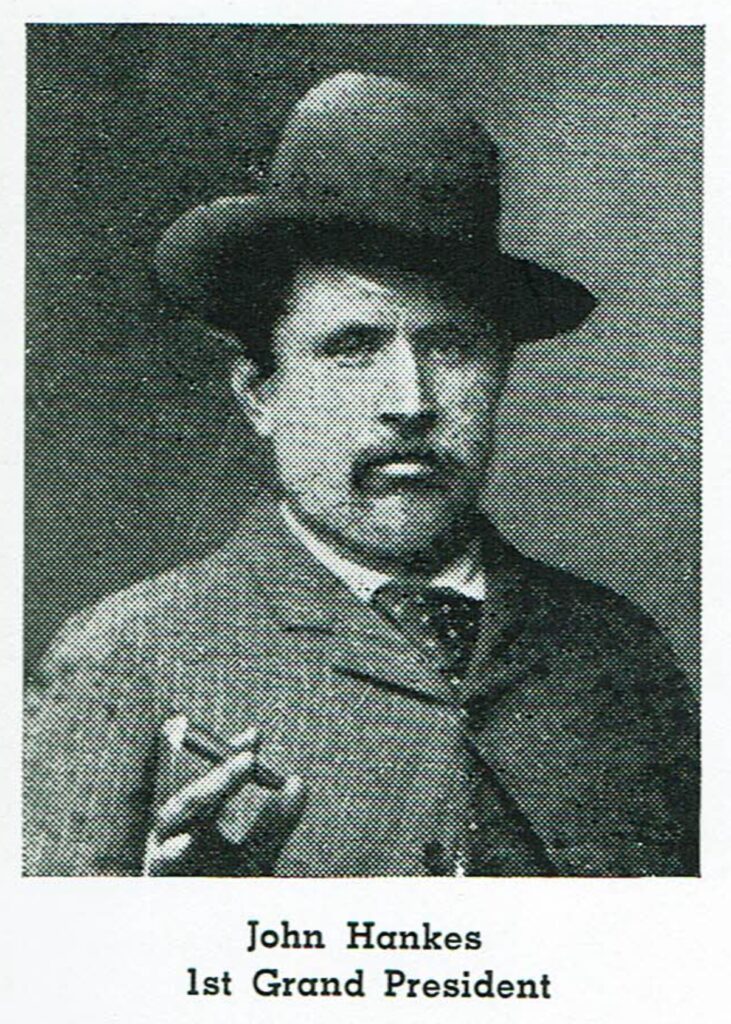
With the establishment of the 2nd Section, it became necessary to form a head-organization, and the 1st Grand Lodge meeting was held on February 14th, 1897. At this meeting the organization of the Luxembourg Brotherhood of America was then definitely established and its Constitution completed.
The election of Grand Officers at this meeting gave the following result:
| Grand President | John Hankes |
| Grand Vice-President | Nick Mausen |
| Grand Secretary | John N. Watry |
| Grand Treasurer | Nick Stirn |
| Grand Trustees | John Diederich, John Schmit, Mathias Berchem |
John Glesener, an ardent and devoted member of Section No. 1, lived at this time in Rogers Park, and in his daily routine he came in contact with many Luxembourgers. He made propaganda for the establishment of a Section in Rogers Park, and soon his efforts were successful. Already at the end of April 1897, he notified the Grand Secretary, John N. Watry, to come to Rogers Park on Saturday, May 3rd, to talk over the proposition with many candidates.
Mr. Watry found 25 candidates present, who were all anxious to join the proposed Section No. 3, L.B.A. Grand Secretary Watry presided at the temporary meeting, and Mr. Peter Weimeskirch acted as secretary. In the course of the meeting, all present pledged themselves to join the Section whereof Mr. Weimeskirch was instructed to write the Grand President and have him come to the next meeting on Sunday, May 9th, 1897, to establish the new Section and install its officers. The Grand President and the other Grand Officers went to Rogers Park at the appointed time, and on this historical afternoon, Section No. 3 was established, and 29 members were initiated.
With the establishment of Section No. 3, the foundation of the Luxembourg Brotherhood was definitely established, and its future looked hopeful and successful. On May 23rd, 24th, and 25th of the same year, the 5th Luxembourg Congress was held at the Northside Turner Hall, in Chicago, Ill, starting with a large parade. At this Congress, the three Sections of the Brotherhood participated, leading the parade with a music band and taking a general lead in the proceedings of the Congress.
The Grand Officers presented at the 1st business session on the second day of the Congress the Constitution of the Grand Lodge with such explanations as were necessary to present a true picture of Brotherhood, but the delegates from the other Luxembourg Societies would not relinquish their own constitution and the workings of their own societies. This was the end of the Luxembourg National Organization as no complete unity was possible.
2nd Annual Convention
The Sections of the Brotherhood expanded and grew in numbers. The 2nd Grand Lodge meeting was held on February 20th, 1898, in Uhlrich’s Hall, Clark and Kinzie Streets, at which most of the members from the 3 Sections were present. After the general routine of business, new Grand Officers were elected to function in the coming year:
| Grand President | John Hankes | Section 1 |
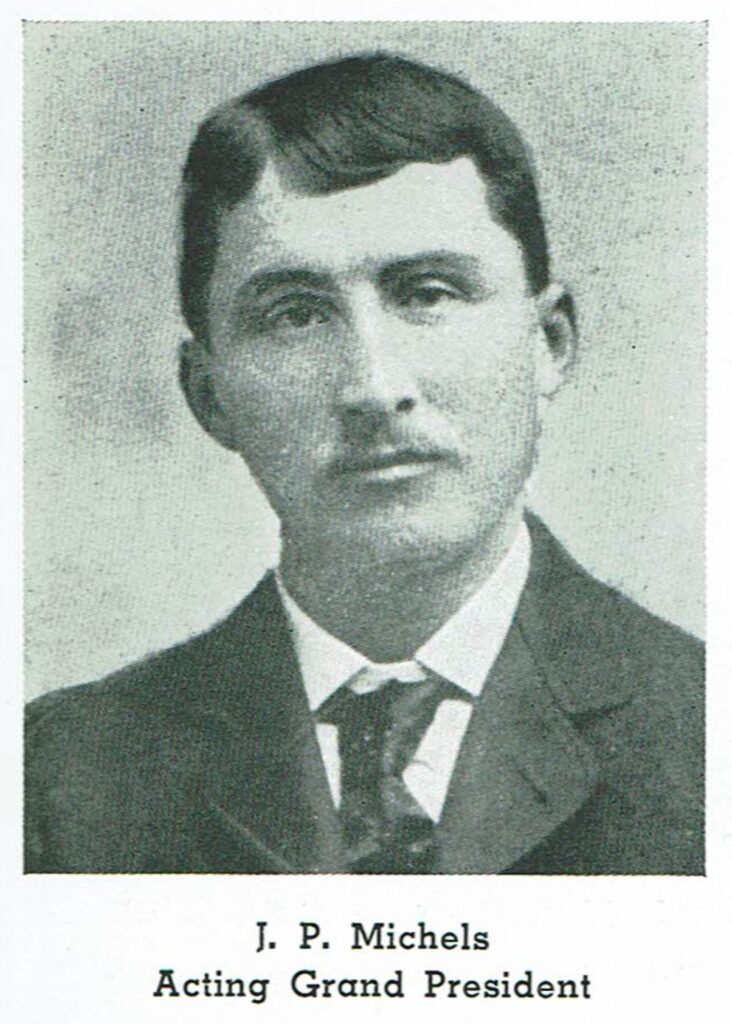
| Grand Vice-President | J. P. Michels | Section 3 |
| Grand Secretary | John N. Watry | Section 1 |
| Grand Treasurer | Nick Stirn | Section 1 |
| Grand Trustees | Nick Mausen | Section 2 |
| Grand Representative | John Schmit | Section 3 |
Third Annual Convention
In the following year, little progress was attained; it seemed as if the societies from the Luxembourg National Society would not give in and affiliate with the Luxembourg Brotherhood, fearing that they would lose their early identity. So, at the time the 3rd Grand Lodge meeting was held on February 12th, 1899, we find fewer members in the Brotherhood than the previous meeting. At this general Grand Lodge meeting, the death benefit was raised from $50.00 to $100.00.
At this meeting, John Schmit was elected as Grand President, Nick Nilles of Section No. 3, as Grand Secretary, and Math. Huss as Grand Representative in place of John Schmit. After the meeting, a public installation of the new Grand Officers was conducted by E. N. Bellar, a member of Section No. 1, and was followed by a grand ball.
On September 15th, 1899, a Special Grand Lodge meeting was called at Orpheus Hall, 49 La Sale St., to regulate the payment of sick benefits. This conformed with a law of the Illinois Legislature, which had been passed in 1892, making it compulsory for benefit organizations to have at least 500 or more members. At this particular time, steps were taken by the Insurance Department to have all benefit societies comply with this provision. In all these years, the Luxembourg Brotherhood had not been requested to meet the demands of this law, but now pressure was put on all benefit organizations to meet the requirements of this law.
The Charter of the “Luxembourger Unterstuetzungs Verein” was at this time revoked, but through political pressure additional time was granted to the Luxembourg Brotherhood to increase its membership to the required number of 500.
At this time the Brotherhood had only 130 members, and at first the task seemed almost impossible. However, united efforts were made, and in the January meeting in 1900, Section No. 1 initiated 35 new members and in the following meeting an additional number of 23 members were accepted. That year 75 new members were initiated in Section No. 1 and Sections No. 2 and 3 more than doubled their membership.
At about this time the old Luxembourger Unterstuetzungs Verein (Luxembourg Benefit Society), located on the north side of Chicago, made an attempt to enter its society No. 4 into the Luxembourg Brotherhood of America. A committee consisting of Bernard Prost, Martin Werks, Peter Jungels, Peter Reiter and Jacob Schaak met with a committee of the Brotherhood consisting of J. P. Michels, Nick Stirn, J. N. Watry, and Nick Mausen to make the necessary adjustment for adoption of the Luxembourg Benefit Society into the Luxembourg Brotherhood as Section No. 4.
At a special meeting of the Grand Lodge, held on February 18th, 1900, in Koch’s Hall on Randolph St., the affiliation was agreed upon, whereby each member of the Benefit Society under 60 years of age, was admitted to the Brotherhood by paying a tax equal to the per capita amount in the treasury of the Brotherhood at that time. Members over 60 years of age were admitted as honorary members. A short time thereafter, Section No. 4 was duly established, and its officers were installed by the Grand Vice President, Mr. J. P. Michels, who was at that time Acting Grand President, owing to the absence of the Grand President from the City.
4th Annual Convention
On May 6th, 1900, the delegates from the new No. 4 Section assembled for the Annual Grand Lodge Meeting, which was held in Ulrich’s Hall, Chicago. Grand Vice President J. P. Michels presided in the absence of Grand President John Schmit. Enthusiastic methods were proposed to increase the membership to the necessary number of 500, and a certain amount of money was voted to help reach this goal. At this meeting, Grand Vice-Presidents were elected for each affiliated Section, with the following results:
| Grand President | J. N. Watry | |
| Grand Vice Presidents | John Diederich | Section No. 1 |
| William Tibesart | Section No. 2 | |
| J. P. Michels | Section No. 3 | |
| Bernard Prost | Section No. 4 | |
| Grand Secretary | Nick Nilles | |
| Grand Treasurer | Frank Dieschbourg | |
| Grand Trustee | Theo. Abends. |
As had been done after the previous Grand Lodge meeting, another ball was held.
Regime of Grand President J. N. Watry
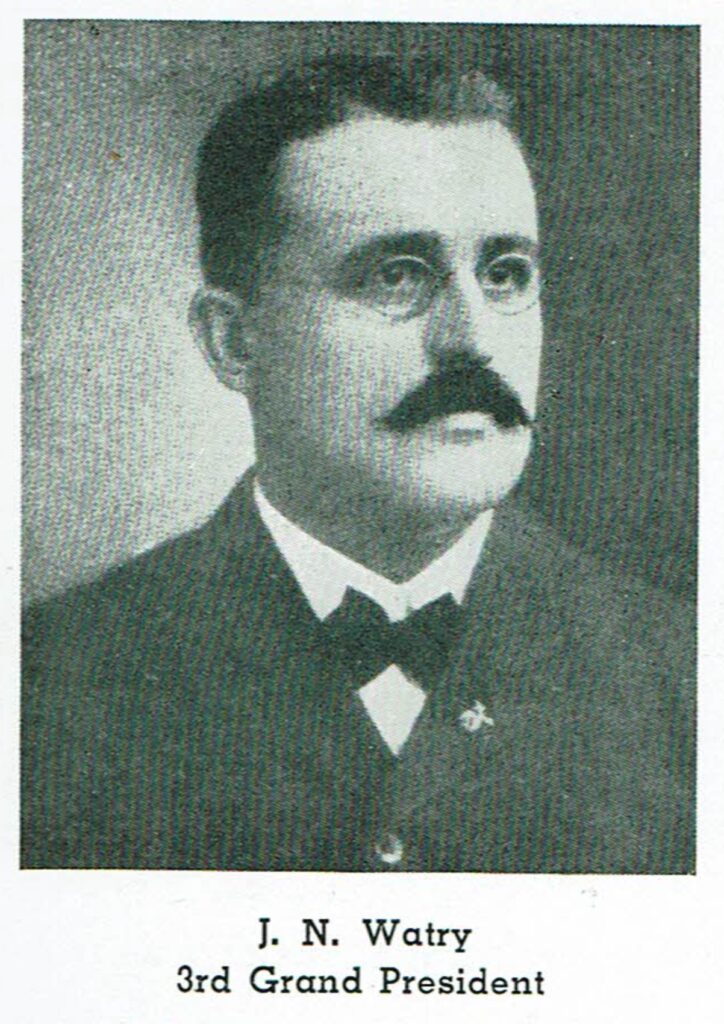
Systematic methods were employed by the new Grand President, John N. Watry, to increase the membership of the Brotherhood. With the assistance of Henry Schmalen, he was successful in getting the Luxembourg National Benefit Society Town Lake to join itself with the Brotherhood; two weeks after a meeting held by this society on September 9th, 1900, it affiliated itself as Section No. 5 with the Luxembourg Brotherhood of America.
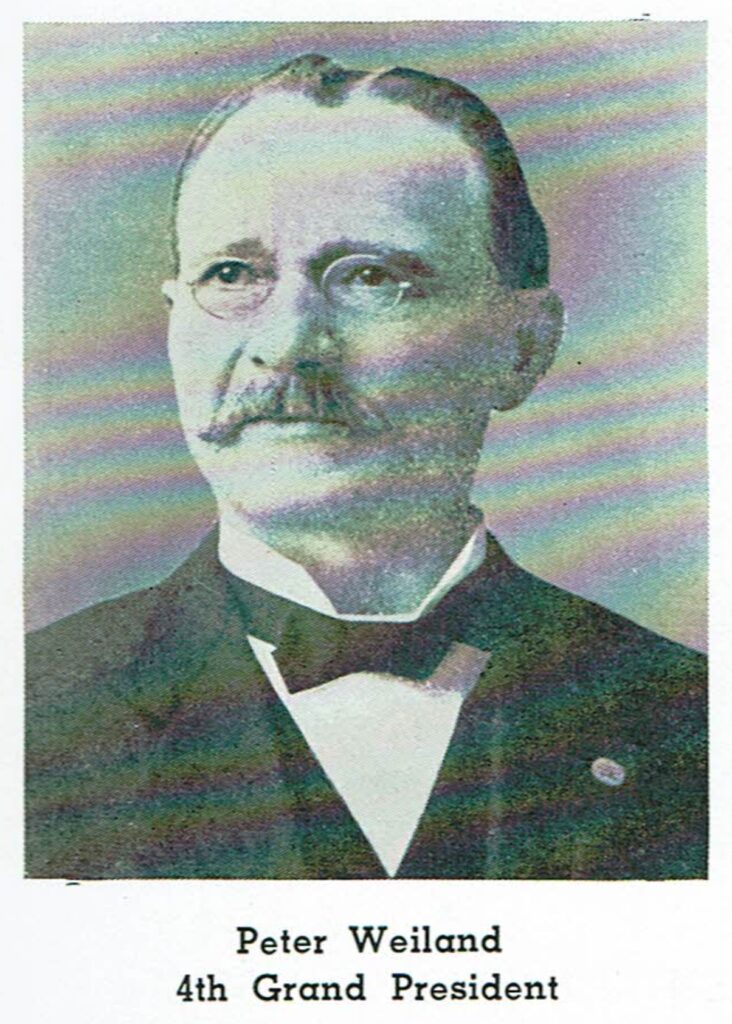
At about the same time other members had made efforts in Hawthorn and Aurora to establish Sections in these towns. In both instances their efforts were crowned with success and on September 30th, 1900, Section No. 6 of Hawthorn was established and its officers installed. On the following Sunday, October 7th, Section No. 7 was established due to the energetic efforts of Peter Weiland, former president of the Luxembourg National Society, who became now the 1st president of the Aurora Section.
A short time after these successes the Luxembourg paper, the “Luxembourger Post”, failed. With it was lost one of the best media to contact the Luxembourger people and the individual members of the various Sections. Grand President Watry realized that without such a medium of contact between the members no ultimate success could be achieved; it might even jeopardize the existing membership of the Sections. On his own initiative and at his own risk, he then established a small monthly paper, known as the “Luxembourger Vereinszeitung”. Through this he kept in touch with the membership of the Brotherhood and informed them of the doings and the progress of their organization.
5th Annual Convention
The provisions of the Constitutions provided that Grand Lodge Meetings should consist only of elected delegates after 5 Sections were established. In view of the fact that the Brotherhood now consisted of 7 affiliated Sections, arrangements were made in all Sections to elect delegates for the next Grand Lodge meeting, which was held on May 5th, 1901, in Hankes Hall at 2525 S. Halsted St., in Chicago.
This was the 5th Annual Grand Lodge Meeting. At this meeting were adopted a new and improved Constitution and a Ritual for the conduct of the meetings. This ritual was drafted by Brother Eugene Bellar of Section No. I and is still in use today, although various changes have been made. Encouraging reports were returned by all Sections and continued efforts were made to bring the total membership up to 500. The same Grand Officers were elected with the exception of Grand Trustee Mausen, who was replaced by Brother B. Prost. The following Grand Vice-Presidents were elected:
| Section 1 | Nick Bodevin |
| Section 2 | Nick Mausen |
| Section 3 | J. P. Michels |
| Section 4 | B. Klein |
| Section 5 | P. Flammang |
| Section 6 | P. Johns |
During the summer of 1901 little progress was made, but towards the winter of that year, energetic steps were taken to organize the Luxembourgers living in the suburb of Evanston, Ill. Nick. Gans and Hubert Hoscheid, at that time living in Evanston, were the men who started the organization of Section No. 8.
On February 23rd, 1902, 43 members were initiated, and the officers of Section No. 8 were duly installed by the Grand President, John N. Watry, and the other Grand Officers. At about the same time, Michael Mueller and Michael Welter realized that considerable Luxembourgers had established themselves in the Lake View district and soon they had enough candidates to establish Section No. 9. On March 16th, 1902, 21 candidates were initiated in P. Schmitz’s Hall on Lincoln Ave. & Roscoe St.; officers were elected, and Section No. 9 was duly established as a part and parcel of the Luxembourg Brotherhood of America.
Incorporated as Insurance Organization
With the establishment of these two new Sections and the increase of membership in the other Sections, the goal of 500 was attained. Then the necessary steps were taken by the Luxembourg attorney, Mathias Huss, to incorporate the Brotherhood along the lines designated by the Insurance laws of the State of Illinois. On May 21st, 1902, the State Charter was issued in favor of the Luxembourg Brotherhood of America and the same was duly signed by the then Insurance Commissioner, Mr. Henry Yates; whereto also was attached the great seal of the State of Illinois.
In this Charter it was made known that the Luxembourg Brotherhood had complied with all provisions of the Illinois Insurance Law, that it now was legally organized and that it could function as a Sick and Death Benefit Organization.
The following provisions were designated in the Charter:
- 1. The legal name of the organization was Luxembourger Bruderbund von Amerika, (Luxembourg Brotherhood of America).
- 2. Chicago was the headquarters of the organization.
- 3. Authoritative power was vested in a directorate of 7 members, who were to be elected yearly by the Grand Lodge.
- 4. Only persons between the ages of 18 and 50 years were eligible to membership.
- 5. All applicants for membership must pass the required doctor’s examination.
In this manner the Luxembourg Brotherhood of America was legally established as a Luxembourg Benefit Society and its foundation at that time was really sound and constructive.
6th Annual Convention
At the 6th Annual Grand Lodge meeting, held on May 11th, 1902, only one Grand Vice-President was elected, namely, Bernard Klein of Section No. 4. The other Grand Vice-Presidents were replaced by Grand Representatives and the following members were elected:
| Section 1 | Nick Bodewin |
| Section 2 | Nick Mausen |
| Section 3 | P. Malget |
| Section 4 | P. Reiter |
| Section 5 | H. Schmalen |
| Section 6 | P. Flammang |
| Section 7 | M. Diederich |
| Section 8 | M. Schumer |
| Section 9 | Michael Welter |
In place of the deceased Grand Treasurer Frank Dieschbourg, Brother C. J. Lemmer of Section No. 5 was elected. Mueller of Section No. 9 was elected as Grand Trustee in place of Theo. Abens.
On June 14th, 1903, Grand President Watry established in West Pullman, Section No. 10, which had been organized through the efforts of Nick Mausen. 23 members were initiated, and the duly elected officers were installed by the Grand Officers.
7th Annual Convention
The 7th Annual Convention of the Brotherhood took place on February 1st, 1903, at Orpheus Hall in Chicago. Only minor business, with a few changes in the Constitution, was transacted at this meeting. The following changes were made in the selection of Grand Officers:
- Grand Vice-President B. Klein was replaced by Peter Weiland of Aurora
- John Schmit replaced Math. Huss as Grand Trustee
- P. P. Kranz replaced Peter Malget as Grand Representative from Section No. 3
- B. Klein replaced P. Reiter from Section No. 4
- Nick Gans replaced M. Schumer of Section No. 8
- Michael Welter replaced Andrew Welter from Section No. 9
- Nick Lutgen was elected as Grand Representative from Section No.10 in West Pullman
Up to this time the activities of the Brotherhood had been confined to the State of Illinois, but at various times the desire had been expressed to organize Sections in other States where Luxembourg settlements had been established. In the Spring of 1903, John Ries went to reside in Granville, Iowa, and instructions were given him to use his good influence among the Luxembourgers in that town to establish a Section.
With the assistance of Geo. Wagner and Dominick Berg, Section No. 11 of the Luxembourg Brotherhood was duly established in the city of Granville on June 7th, 1903, with a membership of 26 charter members.
8th Annual Convention
At the 8th Annual Grand Lodge meeting held on February 4th, 1904, at the Luxembourger Hall in Aurora, Grand President John N. Watry resigned as Grand President, and he was succeeded by Peter Weiland of Aurora. Other Grand Officers elected at this meeting were:
| Grand Vice-President | Jacob Schaak |
| Grand Representative | J. N. Watry |
| Grand Representatives | Section 1 – Henry Dieschbourg, in place of N. Bodevin |
| Section 3 – Charles Hengesch in place of P. P. Kranz | |
| Section 4 – A. Wagner in place of B. Klein | |
| Section 6 – John Bartz in place of P. Flammang | |
| Section 11 – George Wagner |
The Luxembourg Brotherhood, which had prospered and grown so successfully under the leadership of Grand President John N. Watry, showed equal success under the guidance of Grand President, Peter Weiland. Two new Sections were organized in the first year of his regime, Section No. 12 of Random Lake, Wisconsin on October 27th, 1904, and Section No. 13 of Milwaukee, Wisconsin, in December 1904. Section No. 12 was organized by Frank Wagner and Section No. 13 by the then Grand Vice-President Mr. Henry Dieschbourg.
9th Annual Convention
The success achieved in these last few years was only an incentive for further concentrated action. In the next Grand Lodge convention, held on February 5th, 1905, in Jung’s Hall on Randolph St., in Chicago, a sum of $100.00 was allowed for the purpose of making the Society better known and 500 additional copies of the Luxembourger Zeitung were ordered printed to be used also for this same purpose.
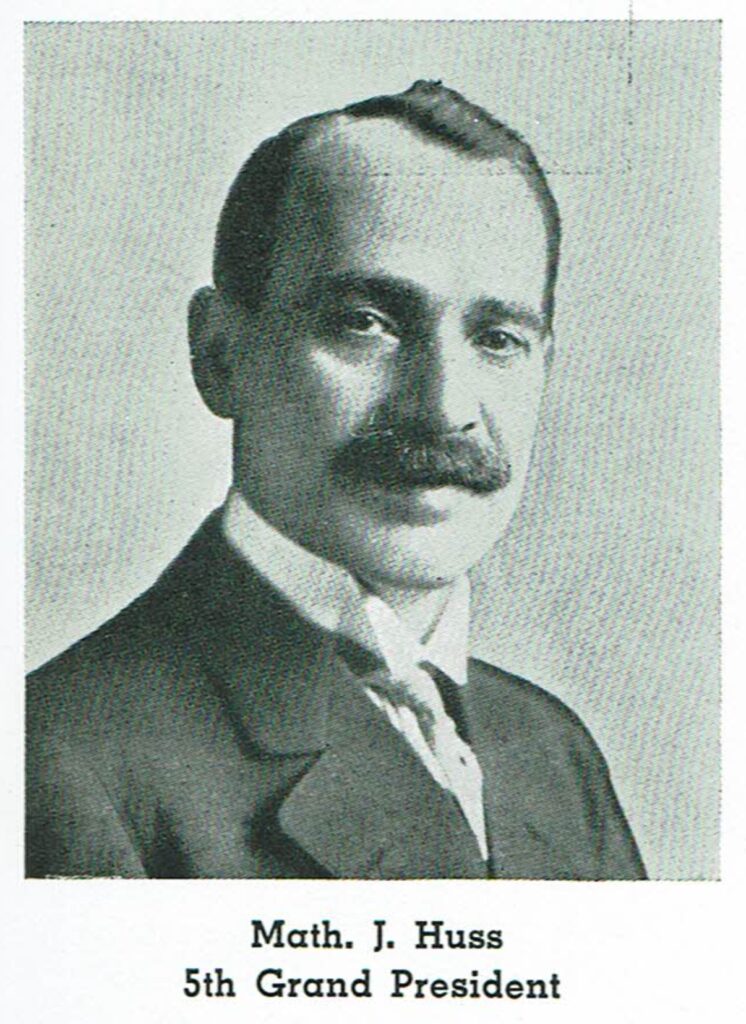
At this convention Math. J. Huss was elected Grand President and under his able and sound guidance 6 new Sections were organized in 1905; Section No. 14 at Remsen, Iowa; Section No. 15 at Niles Center, Illinois; Section No. 16 at Escanaba, Michigan; Section No. 17 on the Westside of Chicago, Illinois; Section No. 18 in Lemont, Illinois and Section No. 19 in Vandergrift, Pennsylvania.
Mr. J. P. Kieffer is credited with the organization of Section No. 14 in Remsen, Iowa; 19 charter members and the new officers were installed on April 29th, 1905. Section No. 15 in Niles Center, Illinois was organized by Joseph Hohs and in July 1905, the Officers were installed by Grand President Math. J. Huss. At the request of the Grand President, John Diederich traveled to Escanaba, Michigan and there made the arrangements to establish Section No. 16; on July 17th, 1905, former Grand President, John Watry, initiated these candidates and installed the elected officers. The same John Diederich organized Section No. 17 and on July 9th, 1905, former Grand President, J. N. Watry conducted the initiation and installation ceremonies.
In the summer of the same year, Section No. 1 made arrangements to hold a picnic in Lemont, Illinois. Upon finding many Luxembourgers in this village, the committee, consisting of Mathias Dillenburg, Nick Mersch and Michael Grein made the necessary arrangements to establish Section No. 19. On August 3rd, 1905, John N. Watry initiated more new candidates and installed the officers in a new Section. Nick Schmit of Section No. 5, who was visiting in Vandergrift, Pa., made arrangements to form Section No. 19 in Vandergrift, and on July 30th, 1905, 15 members were initiated and the elected officers duly installed by Mr. Schmit.
10th Annual Convention
The 10th Annual convention was held in Orpheus Hall in Chicago on February 11th, 1906. It is noteworthy to see in the report of the Grand Secretary Nilles that nearly 350 new members were initiated into the Brotherhood, so that the membership at that time totaled 1186. The Financial report showed a fund in the treasury of $5,317.09 and in the funds of the Section an amount of $17,451.55. At this meeting various changes were made in the Constitution affecting payments of death and sick benefit; a recommendation of the Grand President to raise the amount of the death benefit was not accepted by the convention.
In the summer of 1906, the Grand President Math. Huss and the Grand Secretary Nick Nilles traveled to the State of Iowa and paid an official visit to the Sections in Remsen and Granville. They received a hearty welcome, and their visit inspired many local Luxembourgers to join the above named Sections. Section No. 20 was organized in the City of Dubuque, Iowa, on January 27th, 1907, by Papa Pals and Frank Goehlen with Grand President Huss as the initiating and installing officer. 25 charter members were initiated into this Section and great promises were made to make it one of the best and most influential Sections in the country. These never materialized and Section No. 20 always remained as one of the weaker Sections in the Brotherhood.
11th Annual Convention
The 11th Grand Lodge convention was held in Brincker’s Hall in South Chicago on February 3rd, 1907. There were several new changes proposed in the Constitution, but these were not accepted by the convention. The delegates found it not timely to make changes, in as much as the Brotherhood was progressing so well both financially and in its membership.
Joseph Eischen, a member of Section No. 3 is credited with the organization of Section No. 21 at Gross Point, Illinois. On May 12th, 1907, this Section was duly organized by the Grand Officers. The same year, in the fall season, Section No. 22 of Hospers, Iowa was organized, through the consistent efforts of J. P. Kieffer of Remsen, Iowa. On December 22nd, 1907, 19 candidates were initiated and the elected officers duly installed to make it the 4th Section in the State of Iowa.
12th Annual Convention
The 12th convention of the Brotherhood was held under the auspices of Section No. 3, at Jaeger’s Hall on Devon and Evanston Aves. (now Broadway) in Chicago, Ill. One of the features of this convention was a banquet served by the members of Section No. 3. At this convention the Grand President proposed the establishment of a Luxembourg Home for Luxembourg young men and immigrants. This proposition was submitted to a committee for study and consideration, but the project never materialized.
Section No. 23 was organized in Portland, Oregon, in the year 1908 and in the same year Section No. 24 was organized in the City of New York. Although both Sections prospered in the first years of their existence, their distance from the Grand Lodge and the lack of suitable guidance caused them to disband in the year 1912.
It might be of interest to bring to the attention of the members the fact that the Grand Lodge conducted an Entertainment in the Fall of the year 1905. A similar affair, held in the year 1906, was one of great importance, in as much as a Souvenir Program Book of 300 pages was distributed among the visitors. This book has value as a historical document, as it contains the history of the Luxembourg Societies and Luxembourg people in this country, as well as important facts and events of the history of the Grand Duchy of Luxembourg. The last of these festivals was held in 1908, since other Sections were holding picnics and other yearly festivals such as the Schobermesse, Saengerfest, etc., etc.
13th Annual Convention
The 13th Annual convention was held on May 2nd, 1909, in Ziemann’s Hall in Milwaukee, Wisc., with Section No. 13th as host to the delegates. The membership list had grown to 1,485 and the treasury fund amounted to $10,937.59, with an additional amount of $32,975.79 in the funds of the various Sections. Although no new Sections were established in the year 1909 and 1910, the membership in the established Sections increased with each year and the benefit of the Luxembourg Brotherhood of America was felt throughout the various Luxembourg settlements of the country.
14th Annual Convention
The 14th Annual convention of the Brotherhood was held in the City of Dubuque, Iowa, on May 1st and 2nd, 1910, in Eagles Hall. The good people of Dubuque had spared no efforts to make this convention a grand success. A great parade was held on Sunday morning, followed by solemn church services. The convention proper was opened in the afternoon and lasted until the following noon. No changes of great importance were made, and the usual good reports were given by the Grand Schmalen, the Grand Vice-President, who had worked so diligently in the interests of the Brotherhood, had passed away during this past year and John N. Mangen of Section No. 17 was elected in his place.
15th Annual Convention
In the 15th annual convention held in the Teutonia Turner Hall on 53rd St. and Ashland Ave., in Chicago, it was reported that Section No. 25 had been established in Tessville on March 12th by the Grand Officers. At this meeting, held on May 7th and 8th, Mayor Carter H. Harrison was represented by Mr. John E. Traeger, who brought the good wishes of the mayor and gave the delegates the key to the city. Other distinguished guests at this convention were the German Consul Birkhoff, Sheriff Zimmer and Judge Michael Girten.
16th Annual Convention
The 16th Annual Convention of the Luxembourg Brotherhood of America was to be held in Remsen, Iowa, but due to difficult railroad transportation, the convention was held at St. Paul Hall on 22nd St. and S. Hoyne Ave., in Chicago, Ill., on May 5th and 6th, 1912. Solemn church services were held in St. Paul’s church at 10:00 o’clock and at 2:00 P. M. the convention was called to order by the Grand President Mr. M. J. Huss. Among distinguished guests at the convention were John E. Traeger, Ex-judge Michael Girten and Father Benno of St. Paul’s Parish, all of whom addressed the assembly, extending their good wishes and encouragement.
At this time the membership totaled 1,642, the Grand Lodge fund was $17,477.84 and the Sections’ funds amounted to $45,351.30. At this convention a resolution was adopted, whereby all suggested changes to the Constitution had to be submitted to the various Sections 60 days before the convention date. It was also decided to limit the convention to one day; this was sufficient time to dispose of the regular business. The per capita tax was raised from 35 cents to 50 cents per year payable in two installments, July 1st and January 1st of each year. John M. Mangen of Section No. 17 was elected as Grand President and Henry Geimer as Grand Vice-President.
Accidental Death of Grand President Huss
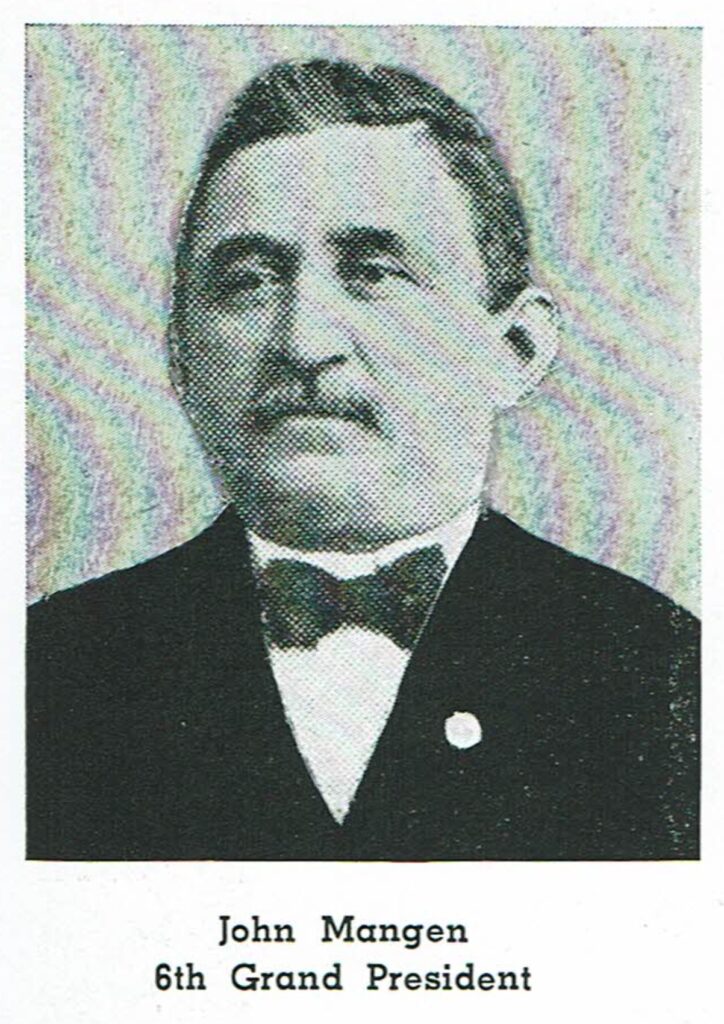
On November 3rd, 1912, the Luxembourg Colony of Chicago, and especially the members of the Luxembourg Brotherhood of America, read with much regret of the fatal accident to Ex-Grand President Math. J. Huss, who was hit by a streetcar. He was taken to the Wesley Hospital where he died on Wednesday, November 6th. He was buried on Sunday, November 10th in St. Boniface Cemetery. His funeral was a grand manifestation of the love and respect that he had merited for himself, for the generous contribution he had made during his life to the Luxembourg colony of Cook County, especially during his regime as Grand President of the Luxembourg Brotherhood.
17th Annual Convention
On May 4th, 1913, the 17th Annual Convention was held in Herdrich’s Hall on Lincoln Ave. and Roscoe St., in the city of Chicago. Sheriff Michael Zimmer of Cook County extended the greetings and good wishes of the Mayor of Chicago, pointing out at the same time that the Luxembourger people had succeeded in many ways in the new fatherland, as was evidenced by the many public offices and the many important positions they held in the industrial world. At this convention the Grand President made several recommendations, among them a membership drive and the celebration of the Silver Jubilee of the Brotherhood.
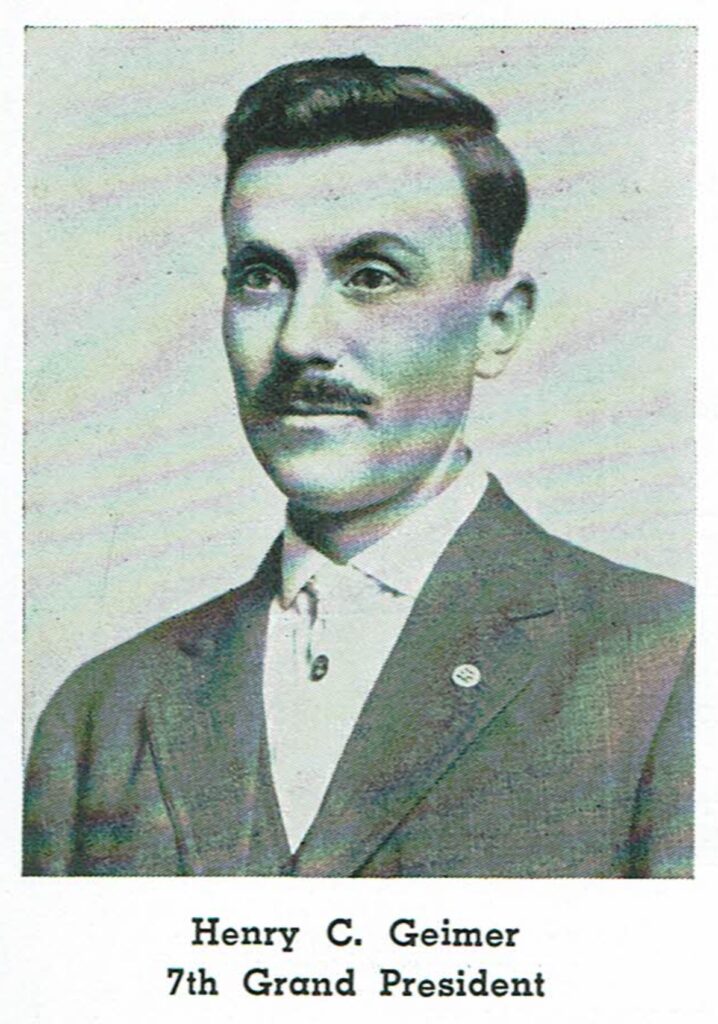
In order to promote and encourage the membership drive, $50.00 was allowed for prizes to the three members who would bring in the highest numbers in the coming year. The convention delegated the Grand Officers and the Grand Representatives to make arrangements for the Silver Jubilee celebration. Henry C. Geimer of Section No. 8 in Evanston was elected as Grand President and Henry Dieschbourg as Grand Vice-President.
Silver Jubilee Celebration
On Thanksgiving Day, November 27th, 1913, the “Silver Jubilee” of the Luxembourg Brotherhood was held in the Lincoln Turner Hall on Sheffield Ave. and Diversey Parkway in Chicago, Ill. It consisted of a Program of entertainment, music, and speeches and it was a grand success. A Souvenir Program book was published on this occasion containing the history of the Brotherhood and its Sections as well as other historical data of the Luxembourg people.
One of the features of the day was the presentation of stereoptic views of Luxembourg and its people with suitable comments by Joseph Winandy. (I distinctly remember how it thrilled my heart, and it must have the same effect on the others, to see the enlarged views of beautiful Luxembourg on the silver screen). The financial success of the Silver Jubilee celebration netted $182.00, which was turned over to the death fund of the Brotherhood.
18th Annual Convention
The 18th Annual convention of the Brotherhood was held in the Masonic Temple, located in the heart of the City of Chicago. The report of the Grand Secretary showed a membership of 1688 active members and 100 honorary members. The treasury report showed a fund of $22904.42 in the Grand Lodge and additional funds of $55942.06 in the various Sections. In view of the fact that no new Sections had been organized in the past few years, particular attention was given at this meeting to the establishments of new Sections in those parts of the country where numerous Luxembourg settlers were located. An initial fund of $100.00 was allowed for this purpose and an additional amount of 15 cents from the per capita tax was voted to this work.
19th Annual Convention
Random Lake in Wisconsin was selected for the 19th Annual convention, which was held on May 2nd, 1915, under the auspices of Section No.12. The beloved old Luxembourg-American poet, Mr. N. E. Becker, extended a hearty welcome to the delegates. This distinguished Luxembourg gentleman, who sang of Luxembourg and its people in his poetry, was presented with an Honorary Membership in the Brotherhood as a token of esteem and respect. “Bechesch Klos” (this was the nom de plume of the venerable old gentleman) valued this Honorable Membership highly. At this convention it was decided to adopt the use of the English language at the convention and the meetings of the Sections. A sum of $200.00 was voted for war relief in the Grand Duchy of Luxembourg.
20th Annual Convention
The 20th Annual convention was held in the City of Aurora on May 7th, 1916, at the Luxembourger Hall, and was opened by Grand President, Henry C. Geimer. Present as guests were the Rev. J. P. Weber of Aurora and the Rev. J. M. Kasel of Milwaukee, Wisc.; both presented their good wishes to the delegates. At this convention it was decided to have the Constitution printed in English as well as in German for the benefit of the younger members of the Brotherhood. Particular attention was given to the hardships of the people in Luxembourg because of the war and the delegates were urged to contribute freely to relief organizations in Luxembourg.
21st Annual Convention
Granville, Iowa was selected to house the 21st annual convention of the Brotherhood which was held on May 6th, 1917, under the auspices of Section No. 11, of Granville, Iowa. One of the important decisions of this year’s assembly was to hold the conventions of the Brotherhood bi-annually instead of annually as heretofore. To show their good faith in their new country the convention proceedings records that a resolution was dispatched to the President of the United States of America, wherein the membership of the Luxembourg Brotherhood pledged loyalty and allegiance and promised full support to the President and the authoritative bodies of the country.
22nd Annual Convention
The 22nd convention was held on May 4th, 1919, at the Lincoln Turner Hall in Chicago. This was a most important convention, in as much as the country was feeling the aftereffects of the war and the whole world was passing through trying and hard times. It was also the year of the Influenza epidemic and, as can be seen by the report of the Secretary, the Brotherhood had lost 209 members since the last convention; only 100 new members had been initiated, making a net loss of 109 members. $1,000.00 was invested in Victory Bonds by this convention and $100.00 voted for the peace celebration to be held in October in the 8th Armory Hall in Chicago.
Reports also show how loyal the Luxembourgers were during the period of the war, how many of them volunteered into the services of the country, and how the Sections as well as the individual members contributed generously to the various relief funds and supported the government in all its undertakings. The loyalty of the American citizens of Luxembourg birth and extraction was publicly acknowledged by distinguished persons on various occasions.
National Convention of all Luxembourgers in the United States
At this convention the Grand President read a report on the National Convention, which had been held by the Luxembourgers in the United States on November 17th, in Chicago, Illinois. At that time the independence and the security of the Grand Duchy of Luxembourg was in danger. It may be noted here that the great majority of the delegates to his historical convention were mostly members of the Luxembourg Brotherhood of America and that the provisions and actions taken by this convention were referred to the Grand Officers of the Brotherhood for final disposition and execution. In order that the historical documents, which brought about the continued Independence of the Grand Duchy of Luxembourg may be preserved for future generations, I am herewith presenting them in their original form.
RESOLUTION
Adopted on November 17th, 1918, at the National Convention of the Luxembourger Societies and People of the U.S.A.
To His Excellency Woodrow Wilson,
President of the United States of America:
WHEREAS, the Government of the Grand Duchy of Luxembourg, whose country was over-run by the armies of the Imperial German Government, notwithstanding the solemn protest of its people and prior to the invasion of Belgium, having appealed to the President of the United States of America requesting evacuation of its country by the German armies, and,
WHEREAS, Thousands of Luxembourgers and Americans of Luxembourger descent have shed their blood for the grand cause of Democracy, fighting under the flags of the United States and Allied Nations, therefore, be it
RESOLVED, that in mass meeting and National Convention assembled at Chicago representatives of the entire body of American citizens of Luxembourg descent, endorse the above mentioned appeal and further that the President of the United States of America use his good offices to the end:
FIRST, That the Independence of the Grand Duchy be permitted to send a representative to the Peace Conference.
Signed:
| Xavier Prum | Nickolas J. Schrup | Michael Majerus | J. P. Mathieu |
| Peter Schoos | Michael Loutsch | Leo Bree | John May |
| J. P. Hemper | Mrs. Susan Karels | Peter Weiland | Nickolas Gonner |
| Joseph Winandy | Eugene Huss | Joseph Hoss | P. L. Hoffman |
| Michael M. Welter | Joseph Dax | Henry Dieschbourg | Mrs. Barbara Kohn |
| Mrs. Margaret Seil |
| Chairman | Peter P. Kranz |
| President | Henry C. Geimer |
| Secretary | Nick Nilles, Secretary |
A copy of the above resolution was also forwarded to Her Royal Highness, Charlotte, Grand Duchess of Luxembourg and one to His Excellency the Prime Minister of the Government of Luxembourg. It was the privilege of the writer of this history to address the delegates National Convention on the important problems of the day and the vital interests that concerned every Luxembourger. This speech was printed in full in the proceedings of the convention, and 2000 copies distributed among the Luxembourger people in various parts of the country.
In the month of February, a petition was circulated among all Luxembourg Societies which was later sent to the American Peace Delegation, imploring them to use their good influence in preserving the Independence of Luxembourg and to seek for Luxembourg economic connection with Belgium, On February 8th, 1919 the following Cablegram was sent:
American Peace Delegation, Paris
Undersigned Grand Officers of the Luxembourg Brotherhood of America in meeting at Chicago resolved to respectfully request your influence that Luxembourg be preserved independent political organism and economically associated with Belgium.
Signed by the Grand Officers
Shortly thereafter, the Grand President received from Luxembourg the following communication.
Luxembourg, March 3, 1919
Mr. Henry C. Geimer, President,
Luxembourg Brotherhood of America.
We had the honor to send you the following telegram on January 20th, 1919.
The General Assembly of the Federation of the Agricultural Associations representing all the Luxembourger farmers sends greetings to the National Convention of Luxembourgers assembled in Chicago, thanks their fellow patriots for the great help to conserve the independence of our country. We beg you to increase your efforts with President Wilson so that the Peace Congress will give the Luxembourgers the right to dispose of themselves.
We have the honor to confirm the above telegram by the present letter. We would be glad to have you acknowledge the receipt of telegram and letter.
We are sure that the unanimous sentiment of the Luxembourger farmers are in favor of the maintenance of the independence of our country, so dear to you and us. Your influence with the proper persons will go a long way in helping the triumph of our cause.
(Signed) Federation of Agricultural Associations of the Grand Duchy of Luxembourg.
At this convention the following communication of Thanks was sent to the Government of Luxembourg.
To His Excellency, the Minister of State and the Honorable members of the Chamber of Deputies of the Grand Duchy of Luxembourg The Luxembourg Brotherhood of America in regular convention assembled in Chicago, Illinois, on May 4th, 1919, takes this opportunity to express to you its thanks and appreciation for the courtesy and hospitality extended by the people of Luxembourg to the officers and soldiers of the United States Army during their sojourn in the Grand Duchy.
The returning soldiers speak in very high terms of Luxembourg and her people and are grateful for the courtesy extended to them.
The Luxembourg Brotherhood of America takes pleasure in acquainting you also with its activities in behalf of the future of the Grand Duchy of Luxembourg. Thousands of American citizens have petitioned the American Peace Delegation in Paris and several cablegrams were transmitted to the representatives of the United States of America, that they may assist Luxembourg in achieving a stable future by establishing its independence politically and providing for economic association with Belgium.
(Signed) LUXEMBOURG BROTHERHOOD OF AMERICA,
Grand-President Henry C. Geimer
Grand-Secretary Nicholas Nilles
And thus, one of the most important conventions of the Luxembourg Brotherhood came to a close.
23rd Annual Convention
The 23rd convention of the Brotherhood was again held in Chicago in the Lincoln Turner Hall on May 8th, 1921, under the auspices of Section No. 4. In his annual message to the delegates Grand President Henry C. Geimer reported how further action had been taken to insure the Independence of Luxembourg and how ultimately through the efforts of President Woodrow Wilson at the Peace Conference in Paris the Independence of Luxembourg was finally established. He also reported on the official visit made shortly thereafter, in the fall of 1920, by the Hon. Raymond de Waha, Charge d’Affaires for the Grand Duchy of Luxembourg in America.
In as much as the Independence of Luxembourg had been obtained through the
energetic efforts of the Luxembourg people in this country, the Government of Luxembourg recognized these efforts of good will and created diplomatic connection between America and the Grand Duchy of Luxembourg by appointing Luxembourg Consuls in Chicago and Minneapolis. On January 23rd,1921, on the birthday of Her Royal Highness Charlotte, Grand Duchess of Luxembourg, the Hon. Peter P. Kranz was appointed Luxembourg Consul at Chicago, the Hon. Eugene Huss as Vice Consul at Chicago and the Hon. Emil Ferrant as Consul at Minneapolis.
Through the distressing war year, the membership of the Luxembourg Brotherhood suffered a bit, and we find, in the report of the secretary, a membership of 1,638 with a treasury fund of $44,444.99; the Grand Total Fund, of both the Grand Lodge and the various Sections reached $92,716.46. This was indeed a fine financial report, showing that the organization was on a sound basis. At this convention $10.00 was allowed to a committee to form a “Luxembourg Bowling League,” but this did not materialize at that time.
During the course of the past year, Section No. 3 had purchased a plot of Graves at Memorial Park Cemetery for the use of its members and had erected on this plot a grand Monument. The delegates were invited to participate in its dedication on Memorial Day, May 30th, 1921.
At this convention $200.00 was allowed to the Luxembourger Zeitung for the publishing of the convention reports and other official business of the Brotherhood.
24th Annual Convention
On May 3rd, 1925, the annual convention was held at the Odd Fellows Hall in Rogers Park in Chicago under the auspices of Section No. 3, with Grand President Henry C. Geimer presiding. At this convention the membership totaled 1,647 and the combined funds of the Grand Lodge and the Section was $102,827.83. A report of the committee for the Good of the Order proposed that the Ritual of the organization be translated into the English language and this was sanctioned. The important step taken at this convention was the raising of the amount of Death Benefit from $100.00 to $125.00.
25th Annual Convention
The 25th annualconvention was again held at the Odd Fellows Hall under the auspices of Section No. 3 on May 3rd, 1925. The important step taken at this convention was the raising of the amount of Death Benefit from $100.00 to $125.00.
26th Annual Convention
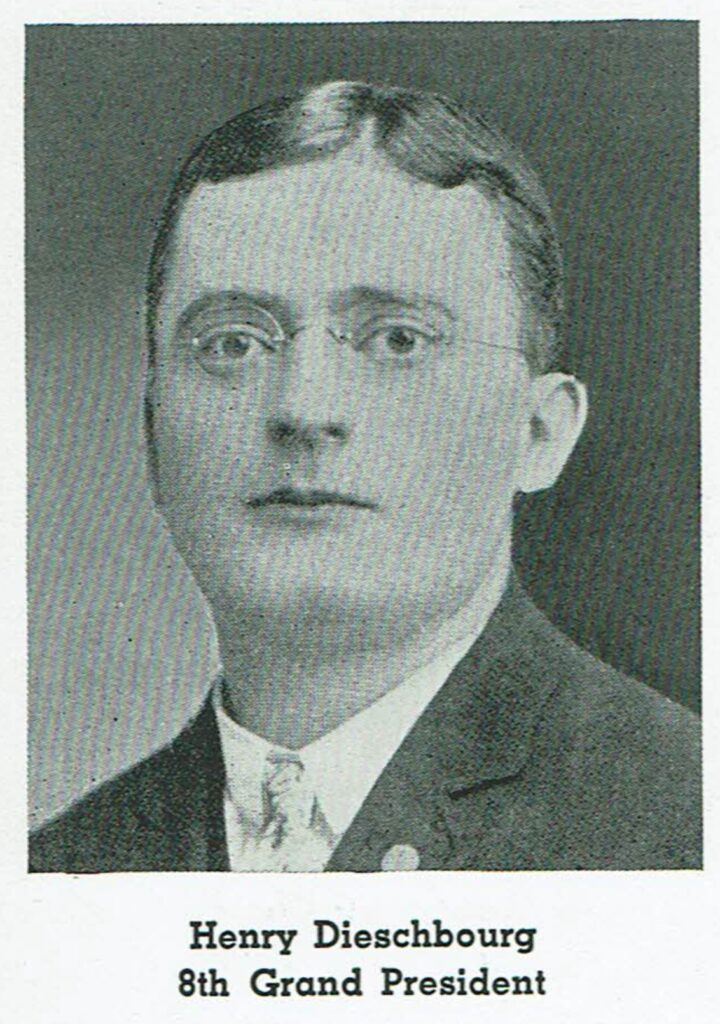
Aurora was the host to the 26th convention of the Brotherhood, held on May 1st, 1927, at the Luxembourger Hall under the auspices of Section No. 7. The former Grand Vice-President, Mr. Henry Dieschbourg presided, having been automatically raised to the Grand Presidency on the death of Henry C. Geimer, who had passed away on November 24th, 1926. Brother John N. Weiland was selected as Grand Vice-President. The membership list had increased at this time to 1,709, and the entire funds of the Grand lodge and the Sections amounted to $126,249.95. At this convention the death benefit was raised again, from $125.00 to $150.00.
27th Annual Convention
The 27th convention was held under the auspices of Section No. 8 at the Redfield Hall in Evanston on the 5th of May 1929. At this convention $120.00 was allowed to the treasurer Peter P. Kransz as part payment of rent, since he had designated his office also the Home Office of the Luxembourger Brotherhood of America. The membership had grown at this time to a new high of 1835 and the combined funds of the Grand Lodge and the Sections went up to $137,105.64.
28th Annual Convention
Financial Crisis of U.S.A. is felt by Brotherhood
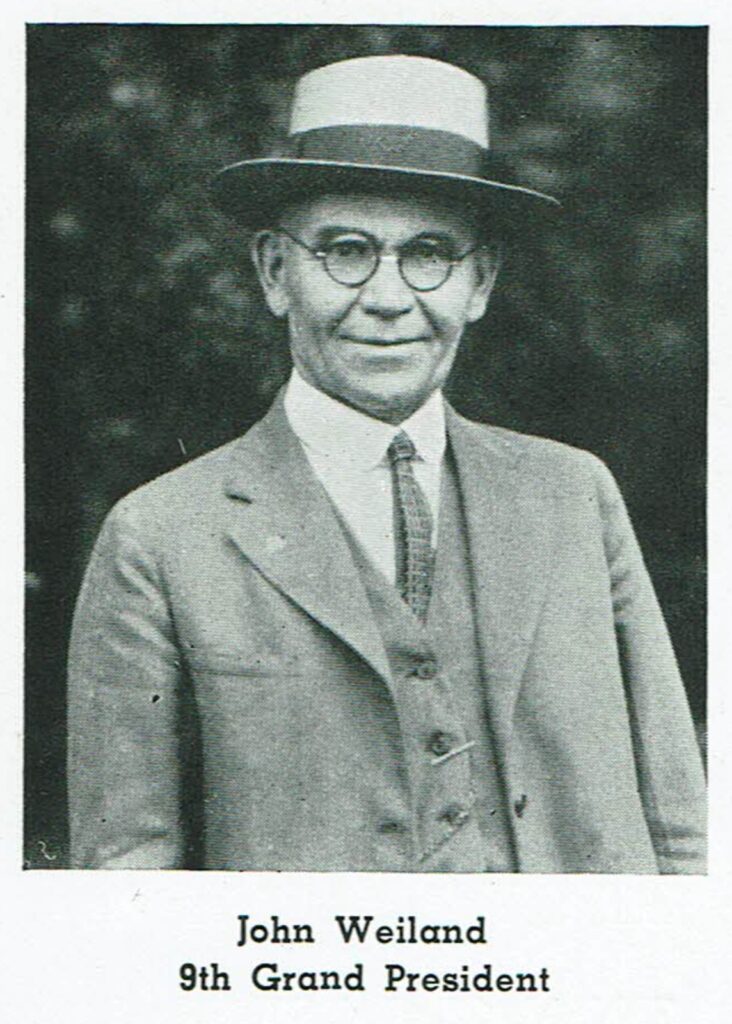
On May 5th, 1931, the 28th convention was held at the Social Turner Hall in Chicago under the auspices of Section No. 9. John N. Weiland presided, having been advanced into the Grand Presidency seat upon the death of former Grand President Henry Dieschbourg, who passed away in November 1930. Although the financial report looked very good on the paper, with a fund of $84,099.25 in the Grand Lodge and a Fund of $65,555.87 in the various Sections, the security of these funds was not so promising; the crash of the 1929 stock market, the closing of many banks and other contributing factors placed a questionable value on the many Gold Bonds held by the Grand Lodge and the Sections.
Interest was not paid on many of them, and serious accusations were made from the floor against the respective finance officers.
29th Annual Convention
When the time came for the next convention, which was held in St. Henry’s Club House in Chicago under the auspices of Section No. 3 the report of the Grand President John N. Weiland was very distressing. In the course of the last two years the depression had brought about a considerable decrease in membership. $67,000.00 of the Grand Lodge fund was invested in Gold Bonds and these had little real value at this time; no interest had been paid on any of them, and the financial situation was most deplorable.
The membership had fallen to 1,489, and the actual fund of the Grand Lodge was only $14,009.35, with Gold Bonds in the amount of $76,000.00 which were probably worth about 25% of their original value. The Grand Treasurer Peter P. Kransz did not attend this convention, and the report which he had sent to the convention was not accepted in the form, as presented, in as much as the paper value of the Gold Bonds and liquidation certificates was given instead of the real value. The quarterly dues were raised at this convention from 50c to 75c and the per capita tax, was cut down from 40c to 25c, leaving the death benefit payment at $150:00.
A motion was made at this convention and a resolution adopted, which petitioned the Government of the Grand Duchy to remove the present Consul General Peter P. Kransz from office and to put in his place the present Consul from North Dakota, the Hon. Perry Daubenfeld.
Fred A. Gilson elected Grand President
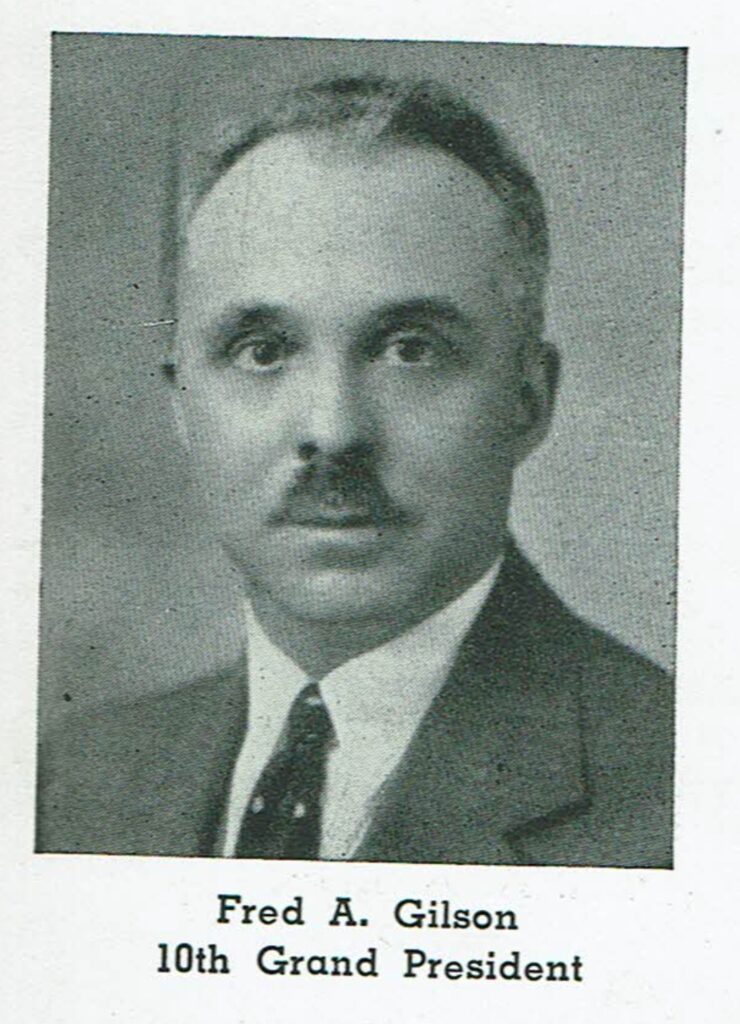
John N. Weiland, who in the past 4 years had worked under most difficult and trying circumstances, asked to be relieved of the burden of Grand President, pointing out that a younger man should be placed in this important office. The writer of this history, Fred A. Gilson, was chosen, in as much as he had rendered valuable service in various capacities in the past, in the Luxembourger cause. The selection must have been a pleasing one, in as much as I have been reelected three times and still hold the office.
Although the road through the years of the depression with its unemployment and its financial crises was a hard one to travel, the Brotherhood never lost its fraternal spirit. It seemed as if new life had been injected into the Brotherhood despite the financial reverses and the losses of many members who no longer could meet their financial obligation.
30th Annual Convention – Organization of Luxembourg Youth
The 30th convention was again held in St. Henry’s Club House under the auspices of Section No. 3 on May 5th, 1935. A confident feeling existed again and with renewed energy the delegates pledged themselves to rebuild the financial difficulties of the Brotherhood. In fact, an improvement was noted in the financial report given by the Finance officers at this convention. A recommendation of the Grand President to find ways and means to increase the membership, which had dropped to 1,351, resulted in an increase to 1,483 in the next year. Especially gratifying was the fact that mostly young men were taken into the various Sections. In view of these healthy conditions, steps were taken to promote sports and other activities.
In the fall of 1935 a Bowling League was organized, and this has been most successful. In the beginning of 1937, a “Luxembourg Youth Organization was organized under the guidance of the Grand President, which has also been very successful. It received the approval of the convention in May 1937, and it is part and parcel of the Brotherhood today.
Members of L.Y.O. must be composed of members of the Luxembourg Brotherhood and the activities are under the supervision of the Grand Lodge.
31st Bi-Annual Convention
The 31st Bi-Annual convention was held on May 2nd, 1937, at St. Peter’s Hall in Niles Center, Ill., under the auspices of Section No. 15. A grand parade was held, and the convention proceedings were most satisfactory. The reports of the Grand officers were very promising, and all members are working to have the Brotherhood soon in its former glory.
At this convention note was taken of the appointment of John Marsch as Consul General of Luxembourg and William Capesius as Vice-Consul of Luxembourg, both stationed here in Chicago. The first replaced former Consul General Peter P. Kransz and the latter replaced the former Vice Consul J. B. Merkels.
Cognizance was also taken of the bestowal of decorations by the Government of Luxembourg on 3 members of the Brotherhood, namely, Dr. John Klein, Nickolas Nilles and the Grand President Fred A. Gilson. All three received the appointment of Knights of the Oak Leaf Crown with its Gold Cross Insignia. Recently the Hon. John Marsch, Consul General, was also appointed as a Commander of the Oak Leaf Crown by the Government of Luxembourg.
New Illinois Insurance Law in effect
With the beginning of 1938 the Brotherhood started to work under the new Illinois Insurance Law, whereby all sick Benefits have to be paid by the Grand Lodge; Sick Benefits had heretofore been paid by the various Sections and the amount thereof and the length of time for payments were left to the discretion of the Sections. Under the present system the Grand Lodge pays $5.00 weekly sick benefit for a period of 12 weeks. And thus, we come to the Golden Milestone of our history. It has been a history of accomplishments, of benevolence and of charity, of loyalty and fraternity and above all, one of harmony and of brotherly love.
We look forward with enthusiasm and confidence; our goal has not yet been achieved, for there is much yet to be done. With God’s help and the protection of Our Blessed Lady of Luxembourg we will continue to build on the structure whose foundation was laid by the old pioneers and settlers, our forefathers. At the Golden Jubilee we renew our pledge of loyalty and devotion to our fellow men.
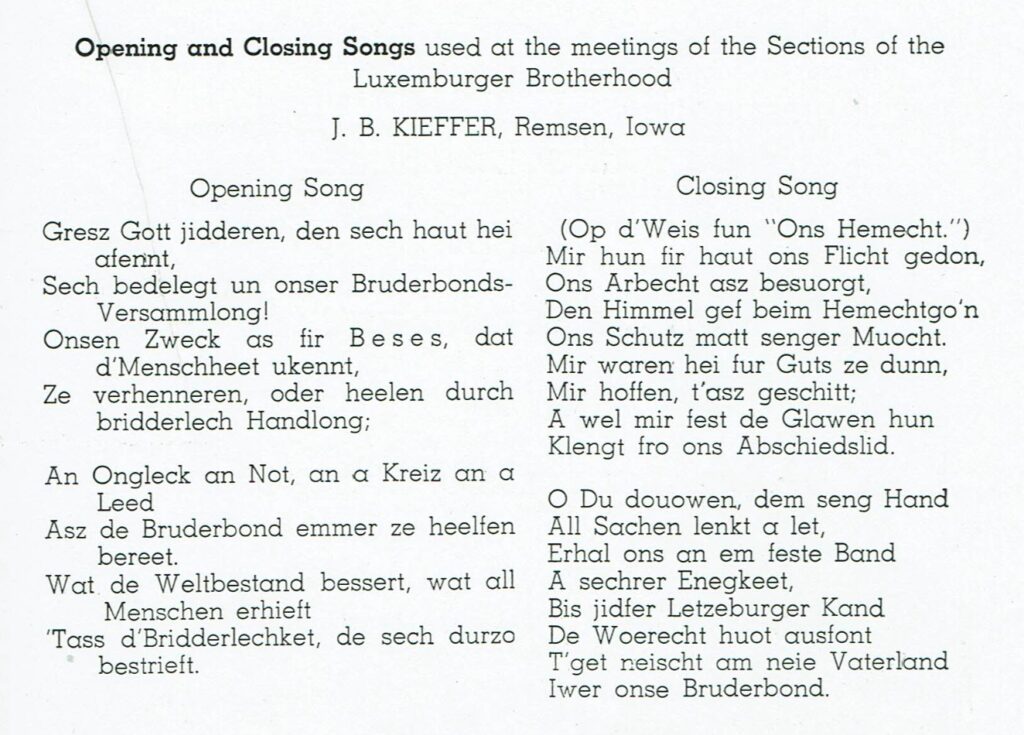
Opening Song – English Translation:
- Gresz Gott jidderen, den sech haut hei afernt,
- —> God greet every soul who gathers here today,
- Sech bedelegt un onser Bruderbonds-Versammlong!
- —> Joining in the meeting of our Brotherhood!
- Onsen Zweck as fir Beses, dat d’Menschheet ukennt,
- —> Our aim is the good that all humanity esteems:
- Ze verhenneren, oder heelen durch bridderlech Handlong;
- —> To prevent suffering—or to heal it—through fraternal deeds.
- Wat An Ongleck an Not, an a Kreiz an a Leed
- —> In misfortune and need, in trial and pain,
- Asz de Bruderbond emmer ze heelfen bereet.
- —> The Brotherhood is ever ready to lend its aid.
- Wat de Weltbestand bessert, wat all Menschen erhieft
- —> Whatever improves the world’s condition, whatever lifts all people—
- “Tass d’Bridderlechket, de sech durzo bestrieft.
- —> That is true brotherhood, forever striving toward that goal.
Closing Song – English Translation:
- Op d’Weis fun “Ons Hemecht.”
- —> To the melody of “Ons Hémécht”
- Mir hun fir haut ons Flicht gedon,
- —> We’ve done our duty for today,
- Ons Arbecht asz besuorgt,
- —> Our tasks are safely through.
- Den Himmel gef beim Hemechtgo’n
- —> And Heaven, pleased to see us home,
- Ons Schutz matt senger Muocht.
- —> Will shield us with its might.
- Mir waren hei fur Guts ze dunn,
- —> We gathered here to do what’s right—
- Mir hoffen, t’asz geschitt;
- –> We trust that it took place.
- A wel mir fest de Glawen hun
- —> With steadfast faith our voices raise
- Klengt fro ons Abschiedslid.
- —> A joyful parting hymn.
- O Du douowen, dem seng Hand
- —> O Thou on high, whose guiding hand
- All Sachen lenkt a let,
- —> Directs and governs all,
- Erhal ons an em feste Band
- —> Bind us in one unshaken band
- A sechrer Enegkeet,
- —> Of sure and steadfast peace,
- Bis jider Letzeburger Kand
- —> Until each Luxembourgish child
- De Woerecht huot ausfont
- —> Has found the honest truth:
- T’get neischt am neie Vaterland
- —> There’s nothing in a distant land
- Iwer onse Bruderbond.
- —> That tops our Brotherhood.
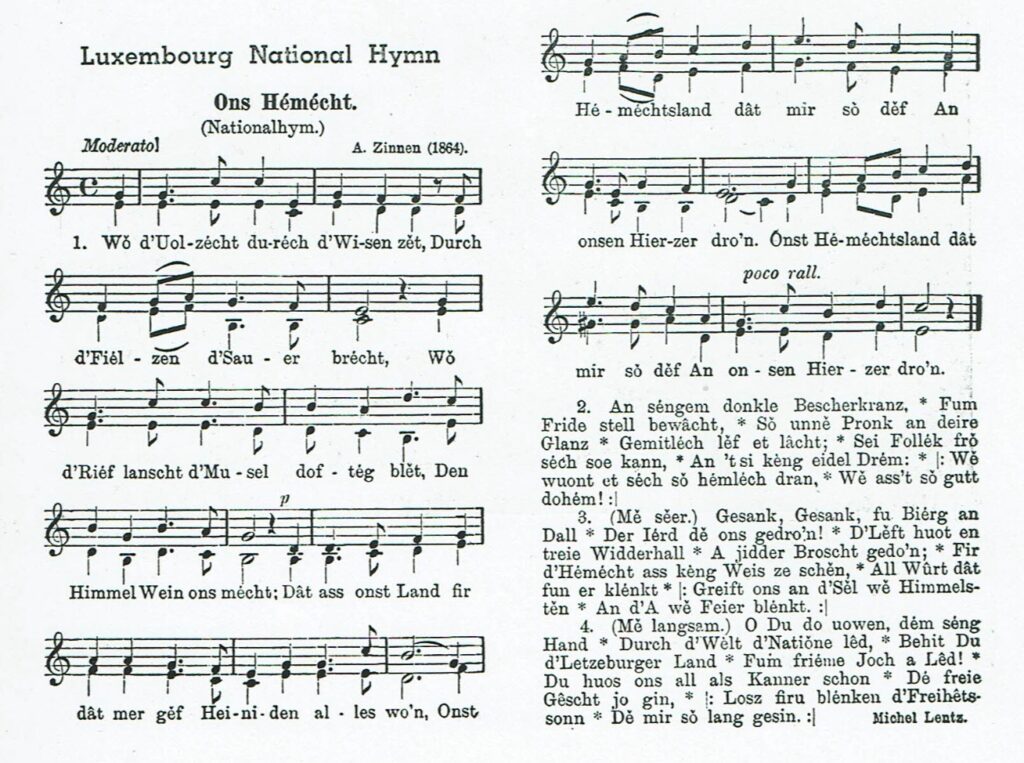
“Ons Hémécht” — Our Homeland
(Luxembourg National Anthem)
Words by Michel Lentz (1859) | Music by Jean-Antoine Zinnen (1864)
VERSE 1
- Wo d’Uol-zecht du-rech d’Wi-sen zet,
- —> Where Alzette winds across the fields,
- Durch d’Fiel – zen d’Sau – er brecht,
- —> And Sauer cleaves the stone,
- Wo d’Rief lansct d’Mu-sel dof – teg blet,
- —> Where fragrant vines along the Moselle
- Den Himmel Wein ons mechs;
- —> Turn heaven’s gift to wine—
- Dat ass oust Land fir
- —> That is the land for which we’d give
- Dat mer gef Heiniden al les wo’n,
- —> That is the land for which we’d give
- Obst He – mechstland dat mir so def An
- —> All that we call our own,
- Onsen Hier-zer dro’n. Onst He-mechsland dat
- —> Our dear homeland, held so deep
- Mir so def An on sen Hier – zer dron
- —> Within each beating heart.
VERSE 2
- An sengem donkle Bescherkranz,
- —> In its dark ring of forest shade,
- Fum Fride stell bewacht,
- —> Kept safe by quiet peace,
- So unne Pronk an deire Glanz
- —> Without bright pomp or costly show
- Gemitlech lef et lacht;
- —> It lives and softly smiles.
- Sei Follek fro sech soe kann
- —> Its people, joyful, need no dreams
- An ‘tsi keng eidel Drem
- —> Of far-off realms sublime;
- We wuont et sech so hemlech dran
- —> So homely is the life within,
- We ass’t so gutt dohem!
- —> So good it feels at home.
VERSE 3
- (Me seer.) Gesank, Gesank, fu Bierg an Dall
- —> Song, O song from hill and vale,
- Der Ierd de ons gedro’n!
- —> To earth that carried us!
- D’Left huot en treie Widderhall
- —> Love finds a faithful echo there
- A jidder Broscht gedo’n
- —> In every human breast.
- Fir d’Hemecht ass keng Weis ze schen
- —> For homeland no tune is too fair,
- All Wurt dat fun er klenkt
- —> Each word that speaks her name
- Greift ons an d’Sel we Himmelsten
- —> Strikes soul like music of the spheres,
- An d’A we Feier blenkt
- —> And sets our eyes aflame.
VERSE 4
- O Du do uowen, dem seng Hand
- —> O Thou on high, whose guiding hand
- Durch d’Welt d’Natione led
- —> Leads nations through the world,
- Behit Du d’Letzburger Land
- —> Protect the land of Luxembourg
- Fum frieme Joch a Led!
- —> From foreign yoke and pain!
- Du hous ons all als Kanner schon
- —> You gave us all, while yet but children,
- De freie Gescht jo gin
- —> The spirit free and brave;
- Losz firu blenken d’Freihetssonn
- —> Let freedom’s sun forever shine
- De mir so lang gesin
- —> On all that we hold dear.
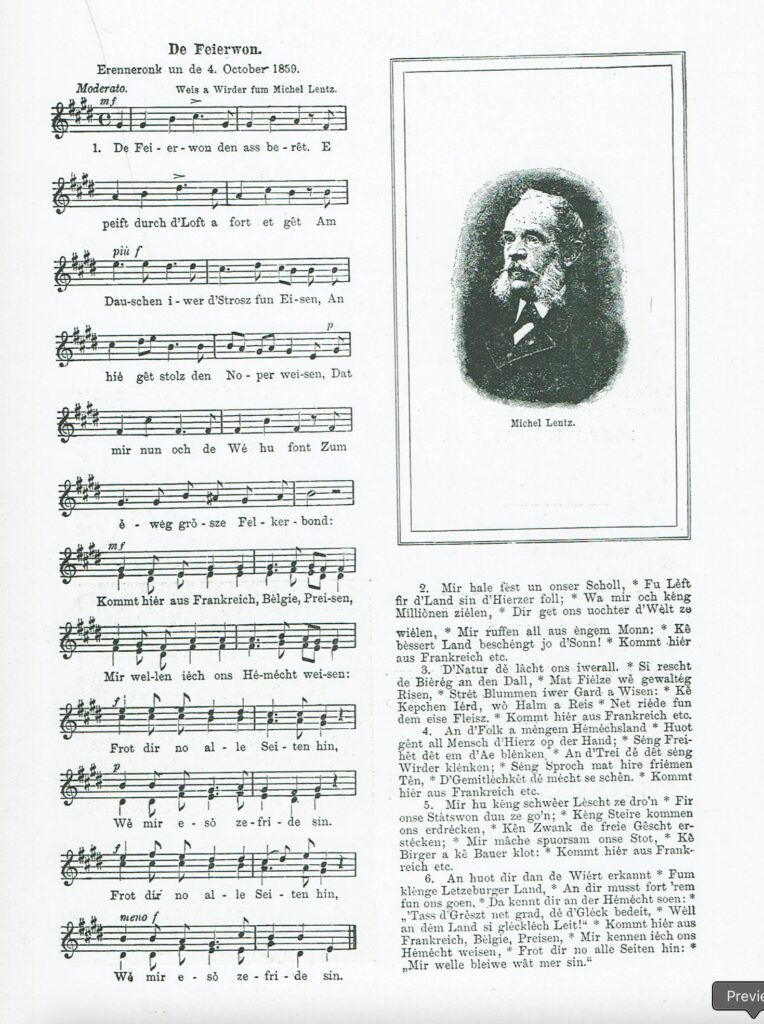
De Feierwon | “The Iron Wagon”
Erenneronk un de 4, October 1859 | In Remembrance of October 4, 1859
VERSE 1
- De Feierwon den ass berêt,
- —> The Iron Wagon now stands prepared,
- E Peift durch d’Loft a fort et gêt,
- —> It whistles through the open air,
- Am Dauschen iwwer d’Strosz fun Eisen,
- —> And rushes down the rails of steel,
- An Hie gêt stolz den Noper weisen, Dat
- —> Proudly the world it makes to feel,
- Mir nun och de Wë hu font Zum
- —> That we as well have found the way
- ëwéggrosse Felkerbond:
- —> To join the grand alliance today:
- Kommt hier aus Frankreich, Bëlgie, Preissen,
- —> From France, Belgium, and from Prussia near,
- Mir wellen iech ons Hémecht weisen:
- —> We call you now—come visit here!
- Frot dir no alle Seiten hin,
- —> We’ll proudly show our native land,
- Wë mir esou zefriden sin.
- —> And how in peace we all still stand.
- Frot dir no alle Seiten hin,
- —> We’ll proudly show our native land,
- Wë mir esou zefriden sin.
- —> And how in peace we all still stand.
VERSE 2
- Mir hale fest un onser Scholl,
- —> We hold fast to our native soil,
- Fu Lëft fir d’Land sin d’Hërzer foll;
- —> For love of land our hearts are full;
- Wa mir och këng Milliounen zielen,
- —> Though we don’t count in millions strong,
- Dir get ons uochtër d’Wëlt ze wielen,
- —> The world must still not do us wrong!
- Mir ruffen all aus engem Monn:
- —> With one voice we proclaim this land:
- Kë bessert Land beschënkt jo d’Sonn!
- —> No fairer place the sun has spanned!
- Kommt hîer aus Frankreich etc.
- —> Come now from France and Belgium near,
- —> And see the homeland we hold dear.
VERSE 3
- D’Natur dë lächt ons iwwerall.
- —> All nature smiles upon our land,
- Si rescht de Biereg an den Dall,
- —> Its hills and valleys proudly stand,
- Mat Fielze wë gewaltég Risen,
- —> Its mighty rocks like giants rise,
- Strët Blummen iwwer Gard-a Wisen:
- —> With flowers blooming ‘neath our skies;
- Kë Käepchen Iërd, wò Halm a Reis
- —> No richer soil for rice or grain,
- Net riede fun dem eise Fleisz.
- —> No land more shaped by honest strain.
- Kommt hîer aus Frankreich etc.
- —> Come now from France and Belgium near,
- —> And see the homeland we hold dear.
VERSE 4
- An d’Folk a mengem Hémechtsland
- —> And in my land, my native home,
- Huot gënt al Mensch d’Hërz op der Hand;
- —> Each heart is warm to all who come;
- Sëng Freijhët dét ëm d’Ae blénken
- —> Its freedom sparkles in the eye,
- An d’Trei dë dét sëng Wirder klénken;
- —> Its faith is voiced in tones that cry,
- Sëng Sproch mat hire friémen Tën,
- —> Its ancient tongue, so rich and true,
- D’Gemittlëchkêt dë mécht se schën.
- —> Its kindness makes all fresh and new.
- Kommt hîer aus Frankreich etc.
- —> Come now from France and Belgium near,
- —> And see the homeland we hold dear.
VERSE 5
- Mir hu këng schwéier Lëscht ze dro’n
- —> We bear no heavy yoke of law,
- Fir onse Stâtsvonn dum ze go’n;
- —> No tax that grips us in its claw;
- Këng Steire kommen ons erdrécken,
- —> No chains to bind the spirit free,
- Kën Zwank de freie Gëscht erstëcken;
- —> No fear to block our liberty.
- Mir mäche spuorsam onse Stot,
- —> We live with thrift, we own our place—
- Kë Bürger a kë Bauer klot:
- —> Each farmer stands with honest face.
- Kommt hîer aus Frankreich etc.
- —> Come now from France and Belgium near,
- —> And see the homeland we hold dear.
VERSE 6
- An huot dir dan de Wïert erkannt
- —> And when you learn these words are true
- Fum klënge Letzeburger Land,
- —> Of Luxembourg, both old and new—
- An dir musst fort ‘rem fum ons goen,
- —> Then even when you leave our land,
- Dà kennt dir an der Hémecht soen:
- —> You’ll say, with heart and voice and hand:
- “Tass d’Grëszt net grad, dë d’Glëck bedeit,
- —> “It may be small, but joy runs deep—
- Wëll an dëem Land si glëcklëch Leit!”
- —> These are the happiest folk you’ll meet!”
- Kommt hîer aus Frankreich, Bëlgië, Preïsen,
- —> So come from France, Belgium, and Prussia near,
- Mir kennen iech ons Hémecht weisen;
- —> We’ll show the homeland we hold dear;
- Frot dir no alle Seiten hin:
- —> Ask near and far, all round the land:
- “Mir welle bleiwe wât mer sin.”
- —> ‘We want to stay just who we are!’
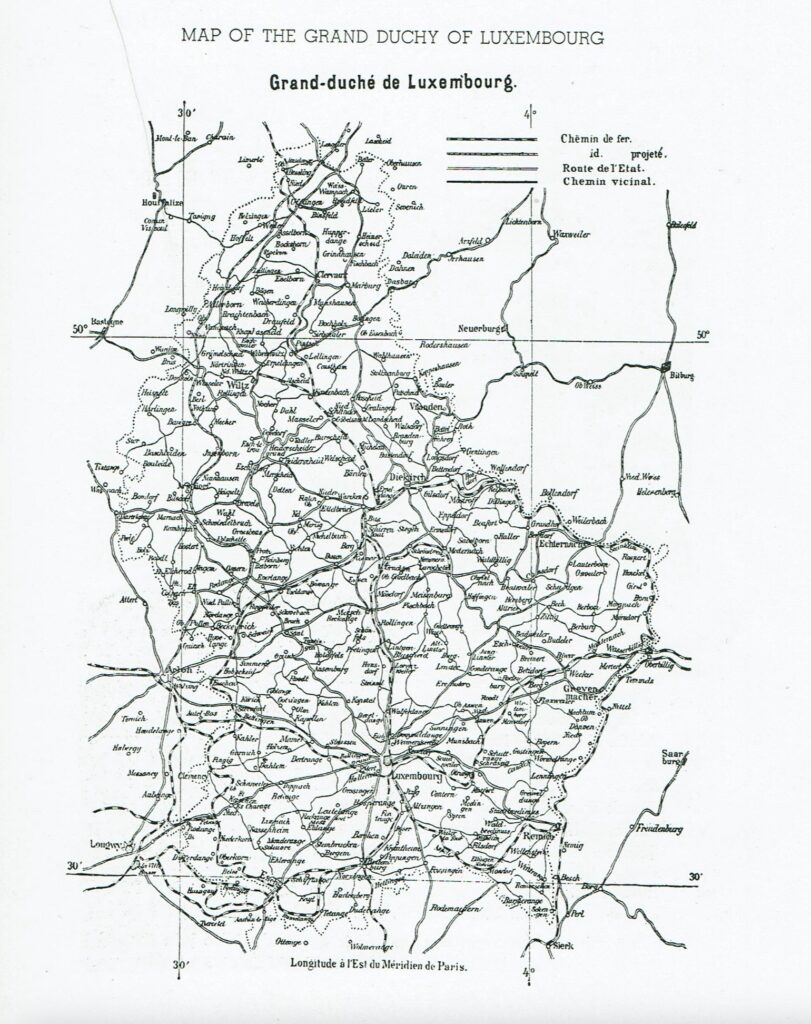
History of the Sections of the Luxembourger Brotherhood
Section No. 1 – South Side
The story of the Luxembourger Brotherhood really starts with the history of Section No. 1. Section No. 1 represented the complete Luxembourger Brotherhood for nearly 10 years until Section No. 2 was organized. The actual history of the Brotherhood, however, starts from the date of the granting of the State Charter, which was issued on Dec. 8th, 1888, in Springfield, Ill.
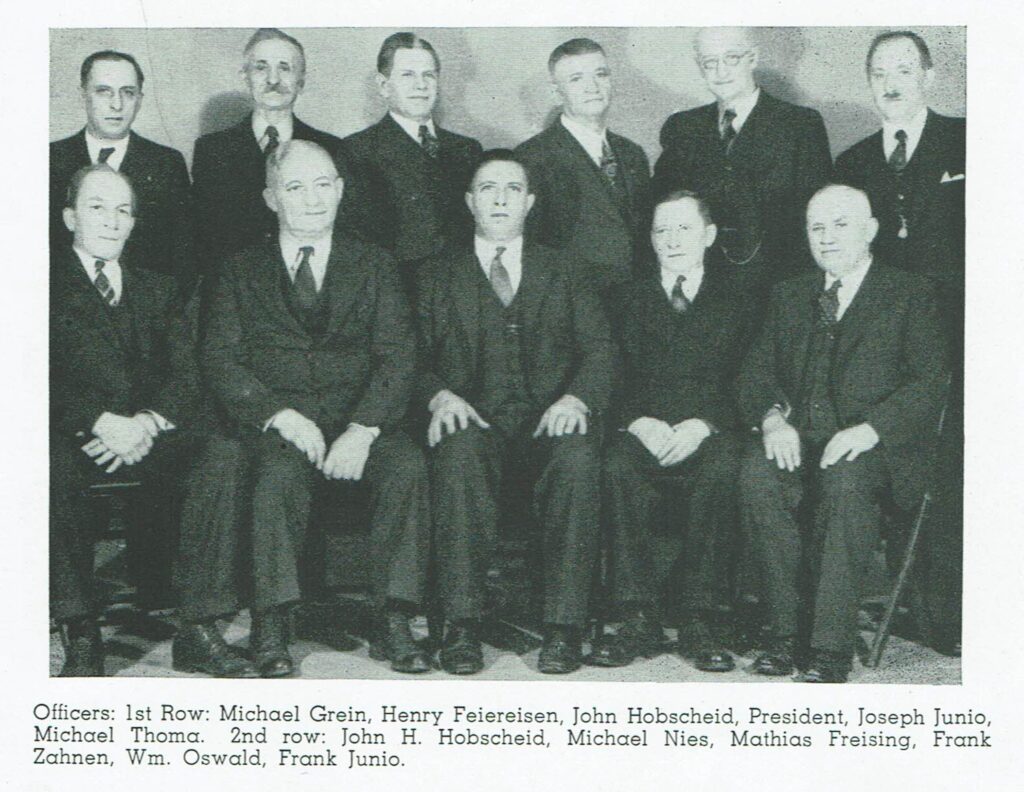
The Charter members of Section 1 were:
| John Diederich | Michael Unsen | Nick Stirn | Nick Cigrang |
| Anton Hankes | John Hankes | Nick Mersch | John Schmidt |
| Edward Turmes | Henry Feiereisen | B. Dieschbourg | J. P. Erpelding |
| N. Feiereisen | W. Paultz | John Schaack | Nick Weber |
| Math. Schils | H. E. Stirn | John Schimberg | Nick Bonert |
| Peter Lentz | Henry Schmalen | Nick Hansen | Gustave Wittwer |
| Jacob Alken | Nick Hubing |
The first set of officers were:
| President | John Schmidt |
| Vice President | Nick Stirn |
| Secretary | Nick Mersch |
| Treasurer | Michael Unsen |
The officers at the time when Section No. 2 was formed were:
| President | John Schmidt |
| Vice President | Frank Dieschbourg |
| Recording Secretary | Wm. Oswald |
| Financial Secretary | Michael Unsen |
| Treasurer | Bernard Dieschbourg |
| Trustees | Nick Stirn, Peter Kohn and Peter Bremer |
| Marshal | John Heintz |
Section No. I was very enthusiastic about the progress of the Luxembourger Brotherhood and gave generously of its experience and talent to each newly organized Section. At the beginning of 1902, Section No. 1 had 150 members, which was really its Golden Age. After this period, many of the members moved to different parts of Chicago and joined other Sections closer to their homes. And because of the changes in the neighborhood, the possibilities of securing additional new members decreased with each year.
A number of the older members of course, and many of those who were later initiated, remained true to their old Section, and although its numbers dwindled to less than 50, Section No. 1 nevertheless remained most active. It still has its regular meetings, still sponsors an annual card party in connection with the Schwesterbund of the South side, still participates energetically in all Luxembourger events.
Their officers as of 1938:
| President | John Hobscheid |
| Vice-President | Math. Freising |
| Recording Secretary | Joseph Junio |
| Financial Secretary | Michael Grein |
| Treasurer | Henry Feiereisen |
| Trustees | John H. Hobscheid, Wm. Oswald and Michael Thoma |
| Marshal | Frank Zahnen |
| Assistant Marshal | Michael Nies |
| Grand Representative | Frank Junio |
Section No. 2 — South Chicago, Ill.
To Mathias Berchem belongs the credit for starting Section No. 2. As a result of his work a number of Luxembourgers gathered together in South Chicago, on January 24th, 1897, where John Hankes, Nick Stirn, Math Berchem, Nick Unsen and John N. Watry organized the new Section.
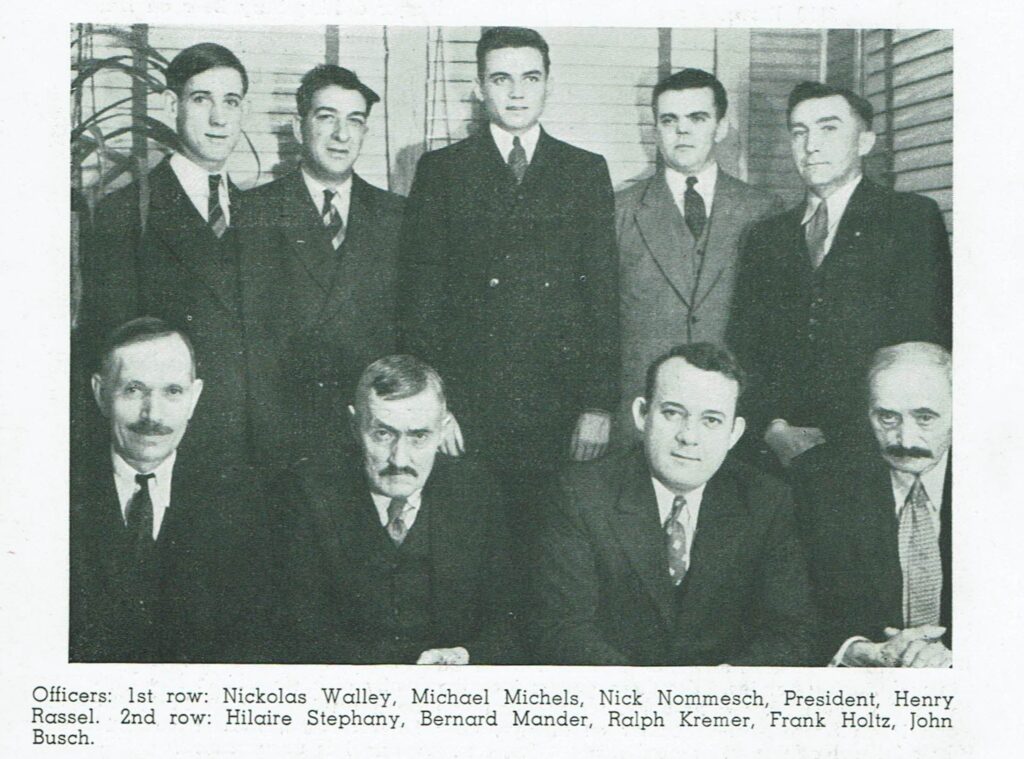
The charter members were:
| Wm. Tibesart | Nick Mausen, Sr. | Nick Arendt | Mathias Fink |
| Peter Schmidt | Henry Rassel | Philip Hames | John Zinnen |
| Thomas Krumes | John Lentz | Nick Nommesch, Sr. | Nick Henerici |
| John Diederich | Nick Tossing | Jacob Bremer |
The first officers elected were:
| President | William Tibersart |
| Vice President | Nick Mausen |
| Recording Secretary | Nick Arendt |
| Financial Secretary | Mathias Fink |
| Marshal | John Lentz |
| Trustees | Henry Rassel, John Zinnen and Philip Hames |
The following charter members are still living and are still members of the Section: Nick Mausen, Sr.; Nick Nommesch, Sr. and Henry Rassel. William Tibesart, the first president of Section No. 2, returned to Luxembourg and is still living in Binsfeld.
An exceptionally faithful and loyal member is Nick Mausen, Sr., charter member, who at the age of 90 years is still active, and still attends every meeting. He represented Section No. 2 for 30 years at the Grand Lodge and is today an Honorary Grand Representative, the only member who has been honored in this manner.
The following presidents have served Section No. 2 since its organization:
| William Tibesart | 1897-1898 |
| Nick Mausen, Sr. | 1899 |
| Jacob Bremer | 1900-1901 |
| Nick Henerici | 1902-1904 |
| Henry Rassel | 1905-1906 |
| George Mamberg | 1907 |
| Nick Mausen | 1908 |
| Nick Henerici | 1909 |
| John Rieland | 1910-1911 |
| Mike Michels | 1912-1916 |
| Nick Henerici | 1917 |
| Mike Michels | 1918-1921 |
| Anton Kanivee | 1922 |
| John Watry | 1923 |
| Mike Michels | 1924-1926 |
| Nick Henerici | 1927 |
| Nick Mauer | 1928 |
| George Mamberg | 1929-1931 |
| Mike Michels | 1932-1936 |
| Mike Kremer | 1937 |
| Nick Nommesch, Jr. | 1938 |
Section No. 3 — Rogers Park, Chicago
Section No. 3, the leading Section of the Luxembourger Brotherhood, was organized on May 9th, 1897, in the Grand Army Hall on East Ravenswood Ave. in Rogers Park.
Rogers Park, High Ridge and the territory surrounding these districts had been settled by the Luxembourger immigrants since the last quarter of the 18th century. Here the old pioneers established themselves, tending their farms and their flowers. They had been raised as gardeners and farmers and naturally as such they established themselves in their adopted Fatherland.
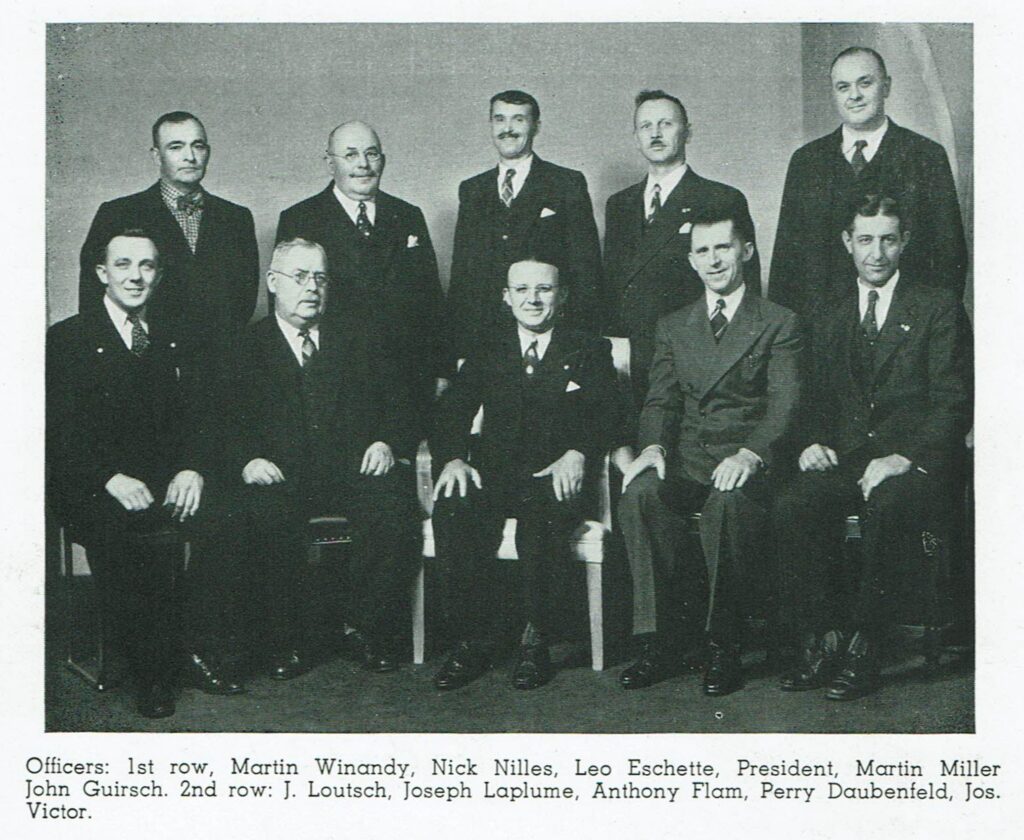
When, in the spring of 1897, Mr. John Glesener came to Rogers Park, he found fertile territory for the establishment of a Section of the Luxembourger Brotherhood. With the assistance of Peter Weimeskirch, Nickolas Nilles, Peter Koob, J. P. Michels and others, this became an easy task and on Sunday, May 2nd of that year, 33 candidates were initiated into the new Section No. 3.
The following officers were elected:
| President | J. P. Koob |
| Vice-President | J. P. Michels |
| Rec. Secretary | Nick Nilles |
| Fin. Secretary | Nick Thinnes |
| Treasurer | Peter Weimeskirch |
| Marshal | Theodore Lanners |
| Trustees | J. P. Jaeger Hubert Hostert and Andrew Weber |
The charter members were:
| J. P. Koob | J. P. Michels | Nick Nilles | Nick Thinnes |
| Peter Weimeskirch | Theodore Lanners | J. P. Jaeger | Hubert Hostert |
| Andrew Weber | Peter Nilles | Nick Drickes | Nick Laplume |
| Mathias Laplume | J. Leichtenberg | John Scholer | Peter Tres |
| J. B. Salentiny | Cor. Kimmes | Fritz Wanderscheid | Peter Eischen |
| Anton Beaufils | Peter Sartor | Vincent Schmitz | Joseph Bill |
| Fred Arendt | Peter Diederich | Louis Clesen | Fred Lutgen |
| Peter Schoos | Theo. Porters | Leon. Schuler | J. A. Schmit |
| Nick Brucher |
From the very beginning up until the present time, Section No. 3 has been the banner Section of the Brotherhood. Its eminent success is undoubtedly due to its location, as most of the Luxembourger immigrants settled in the vicinity of Rogers Park. Credit must be given to its leaders and its members alike, men of clear and far reaching foresight, for its energetic enterprises, its laudable works of charity, and for its devotion and loyalty to the principles of the Brotherhood.
The charitable enterprises of Section No. 3 are manifold. Thousands and thousands of dollars have been disbursed in the cause of charity, not only to members and their families, but to other Luxembourgers and to other citizens as well. The Section has taken a lively interest in all civic and religious affairs, lending its aid to improve the American Commonwealth.
The War record of Section No. 3 is an enviable one. A great number of its members volunteered and served in the United States Army. Some of them gave their lives; others came home with fine records, among them Captain Perry Daubenfeld. The members of the Section gave generously to the various Welfare War Organizations and supported the Government in all its War Loan Drives.
The big social event of Section No. 3 is its “Annual Schobermesse.” This is the yearly banner festival of the Luxembourger people, and it has grown with each year in popularity. For 35 years a selected group of members have worked diligently and faithfully on the many preparations necessary to produce the numerous amusements and entertainments, the yearly Souvenir Program Books, the annual fruit, vegetable and flower exhibits, the grand parade, and the many other attractions. The success of the Schobermesse lies in the generous services of these men.
The following presidents have guided Section No. 3 since its organization, each one serving with credit to himself and the Section:
| J. P. Koob | Andrew Weber | Peter Malget | Chas. Hengesch |
| Peter Thome | J. P. Michels | Peter Nettgen | Jos. Laplume |
| Tony Kremer | Al. Even | Eugene Koeune | Leo Eschette |
Some of the members have established enviable records for length of time in office; probably the foremost of all is Nickolas Nilles, who has held the office of financial secretary continuously since its organization and still does a marvelous job in that capacity. He has also been Grand secretary for about the same length of time almost 40 years and is very greatly informed on matters concerning the Brotherhood and the Luxembourg people. Other members of splendid records include Peter Malget, Fred A. Gilson, Peter Thome, John Guirsch, Joseph Winandy and others too numerous to mention.
The present officers are (1938):
| President | Leo Eschette |
| Vice-President | Martin Miller |
| Rec. Secretary | Nick Nilles |
| Fin. Secretary | Martin Winandy |
| Treasurer | John Guirsch |
| Trustees | Joseph Laplume, Anthony Flam and Perry Daubenfeld |
| Marshal | John Loutsch |
| Assist. Marshal | Joseph Victor |
Section No. 4 – North Side, Chicago
Section No. 4 was organized on May 18th, 1900, when the members of the former Luxembourg Benefit Society of the North Side (Luxembourgers Unterstuetzungs Verein der Nordseite), decided to affiliate themselves, wholesale, with the Brotherhood.
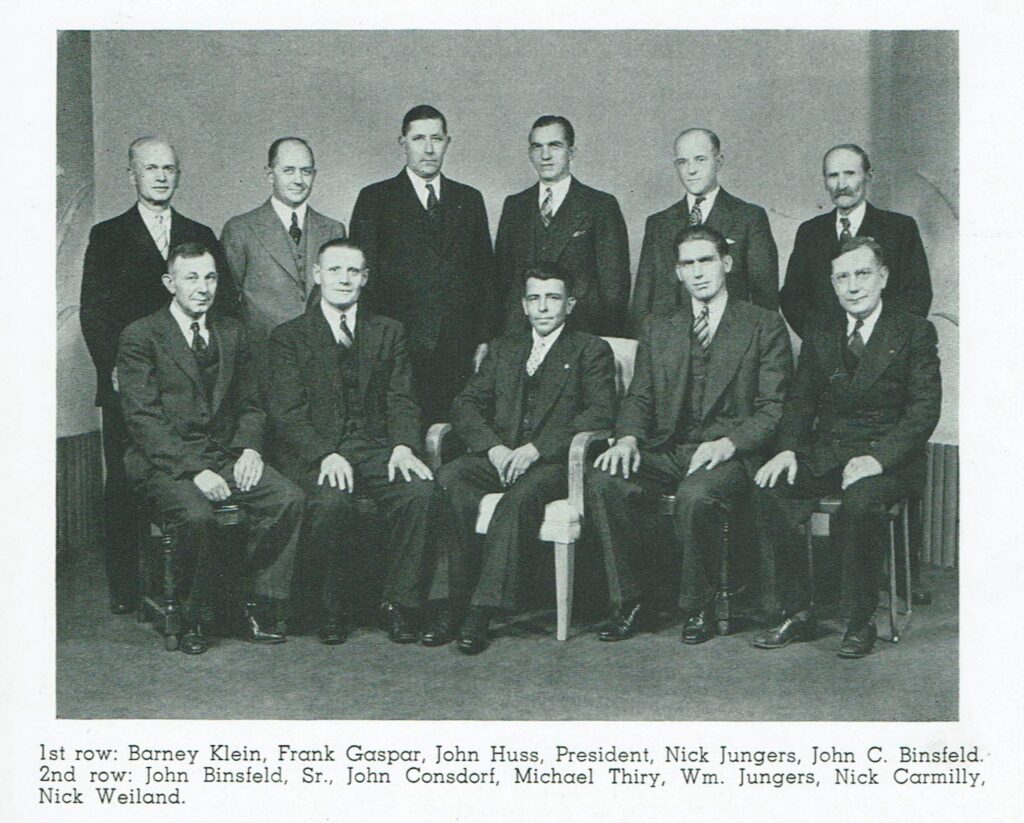
At the time of its organization Section No. 4 had 62 charter members:
| L. Abens | N. Anton | J. P. Berwick | M. Brandeburger |
| C. Birren | J. Binsfeld | M. Burgraff | C. Cordie |
| J. Dreis | G. Fiedler | P. Flammang | C. Feller |
| J. P. Goddart | J. Grosch | N. Glesener | J. Gieres |
| N. Grutzius | N. Guill | N. Hummel | P. Fiedler |
| N. Hansen | J. P. Hentges | P. Irrmann | P. Jungels |
| M. Kass | N. Kirch | M. Kirpach | Frank Kieffer |
| D. Krier | P. Kinn | Barney Klein | P. Kieffer |
| M. Litgen | N. Mersch | J. Mathiew | B. Metzel |
| G. Mangen | J. Meyers | W. Molitor | J. Noesen |
| H. Olsen | B. Prost | M. Prost | F. Peiffer |
| J. Reding | P. Reiter | M. Peiffer | J. P. Sauser |
| J. P. Shommer | J. Schaack | H. Thome | G. Wolf |
| T. Weirich | P. Wampach | J. P. Wilvers | L. Watry |
| J. Watry | N. Weiland | M. Werks | J. Nickels |
Honorary Member, Andreas Lang
The 1st set of officers were:
| President | Martin Werks |
| Vice-President | George Mangen |
| Rec. Secretary | Peter Jungels |
| Fin. Secretary | John Binsfeld |
| Treasurer | Jacob Schaak |
| Trustees | Nick Weiland, Jacob Meyers and Theodore Abends |
Section No. 4 is located in the Lake View District of Chicago and has enjoyed a splendid record ever since its organization. The members are always ready to assist any brother, friend or neighbor in need or distress. Its social life is wholesome and successful, bringing the members of their families and their friends together in thoroughly enjoyable affairs.
At present the officers of the Section are (1938):
| President | John Huss |
| Vice-President | Nick Jungers |
| Rec. Secretary | John C. Binsfeld |
| Fin. Secretary | Frank Gasper |
| Treasurer | Bernard J. Klein |
| Marshal | William Jungers |
| Trustees | John Binsfeld, John Condorf and Nick Karmels |
| Ass’t. Marshal | Nick Weiland |
Of the 62 original members three are still living (as of 1938): John Binsfeld, John Godart and Nick Weiland.
Section No. 5 — Town of Lake, Chicago
Section No. 5, located in the town of Lake, was started on September 23rd, 1900, in Schumacher’s Hall, by the then Grand President, John N. Watry, when the former Luxembourg National Benefit Society (Luxemburg National Unterstuetzungs Verein von Chicago) became transformed into a new Section of the Brotherhood.
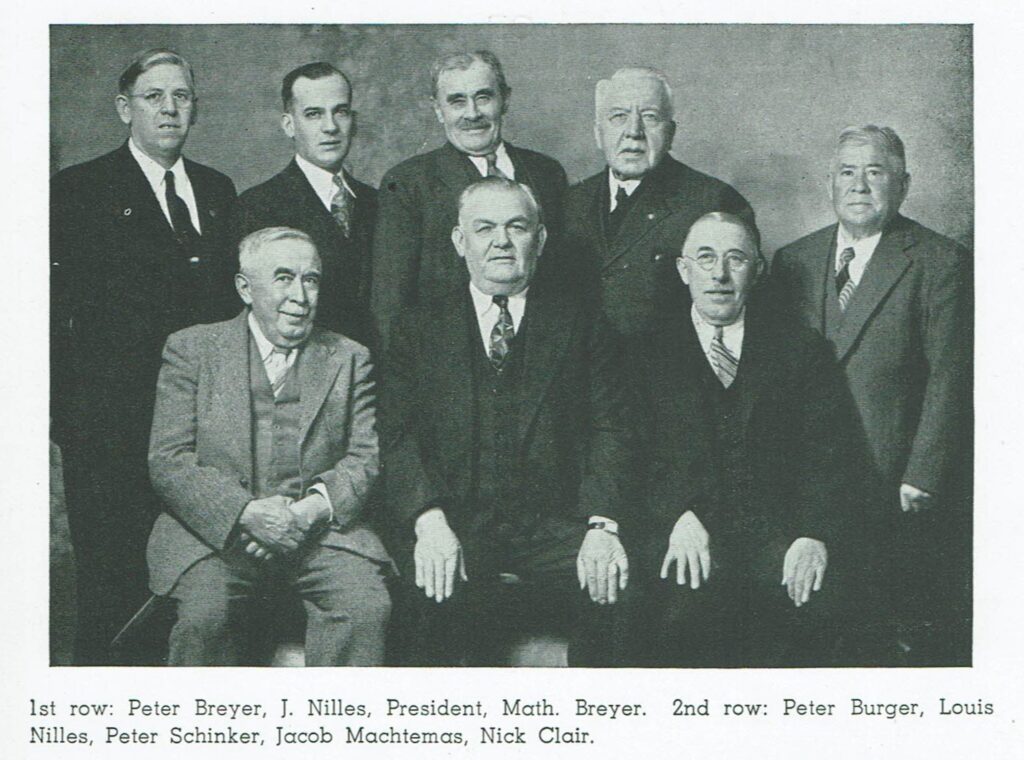
The 1st officers elected were:
| President | Henry Schmalen |
| Vice-President | John Broden |
| Rec. Secretary | John Nilles |
| Fin. Secretary | Math. Manderscheid |
| Treasurer | Frank Wagner |
| Marshal | Frank Schmalen |
| Trustees | Chas. Bouquet, Val. Henkes and Peter Breyer |
| Grand Representative | John Nilles |
The following presidents have guided Section No. 5 in a most capable and faithful manner:
| Henry Schmalen | 8 years |
| Chas. Tohles | 3 years |
| Jacob Wehrer | 6 years |
| John Nilles | 18 years |
John Nilles is still the presiding officer (1938). Peter Breyer has been treasurer of the Section for 35 years and has also been Grand Representative for a great number of years. Section No. 5 was one of the thriftiest Sections in the Brotherhood.
In the year 1915 the Section had 131 members. After this however, this number dwindled down to its present total of 31 when the neighborhood of Town of Lake became settled with other foreign people, and the Luxembourgers moved into better and more desirable neighborhoods.
The present officers are (1938):
| President | John Nilles |
| Vice-President | Math. Breyer |
| Rec. & Fin. Secretary | Louis Nilles |
| Treasurer | Peter Breyer |
| Trustees | Nick Clais, Jacob Machtemes and Peter Schinker |
| Marshal | Peter M. Burger |
| Examining Physician | Andrew D. Schick |
Section No. 6 – Hawthorne, Ill.
Peter Flammang, an ardent member of Section No. 4, was instrumental in organizing the Luxembourgers living in Hawthorne, Ill. into Section No. 6 of the Brotherhood. On September 30th, 1900, he had assembled the following Charter Members, who were initiated on that day by the Grand Officers:
| Mathias Weber | J. Bartz | J. Hilger | Theodore Meyer |
| Theodore Frantzen | J. B. Bertrand | J. Gasper | N. Diederich |
| Theodore Gasper | J. Dirks | J. Lulling | P. Flammang |
| N. Asselborn | Nick Schweig | W. Spang | Nick Schneider |
| J. Theisen | Joseph Binsfeld | J. B. Bruecher | Nick Keiser |
The 1st set of officers elected were:
| President | Mathias Weber |
| Vice-President | J. Bartz |
| Rec. Secretary | J. Hilger |
| Fin. Secretary | J. B. Bruecher |
| Treasurer | Theodore Meyer |
| Trustees | J. B. Bertrand, Theodore Frantzen and Nick Keiser |
| Marshal | J. Gasper |
| Examining Physician | Dr. J. F. Hultgen |
Section No. 6 was very active in the early part of its existence. It had good meetings and fine socials for its members. In later years, on account of the diversion of the population of Hawthorne and the changing of its industries, the membership dwindled and today has only a small membership.
Officers (1938):
| President | Peter Schlentz |
| Vice President | Peter J. Steinmetz |
| Recording Secretary | Harry Schlentz |
| Financial Secretary | Matt Steinmetz |
| Treasurer | Peter J. Steinmetz |
| Marshal | Steve Stanislaus |
| Trustees | J. B. Berand, Jos. Bernsfeld, W. P. Roach. |
Section No. 7 – Aurora, Ill.
Section No. 7 was organized on October 7th, 1900, at a meeting held in Marx’s Hall at Aurora, Ill., with Philip Johns acting as presiding officer and John Bertrand as Secretary.
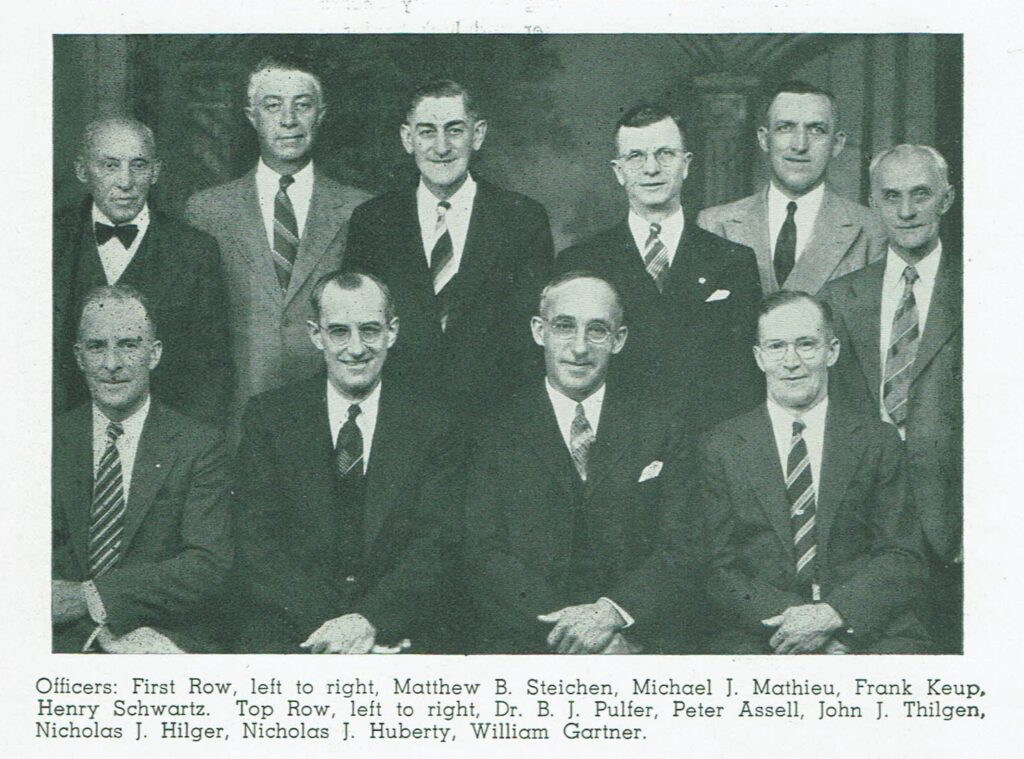
The organizers were:
| Peter Weiland | John Weiland | Peter J. Kartheiser | Nick Frisch |
| M. H. Frieders | John P. Bertrang | Peter Schuster | Philip Johns |
| August Reding | Michael Diederich |
The Charter members are:
| Peter Weiland | John Weiland | John P. Bertrang | Peter J. Kartheiser |
| Nicholas Frisch | Philip Johns | M. H. Frieders | Peter Schuster |
| Lawrence Kartheiser | Nick Kokar | Chas. Weiland | Peter Moutong |
| Michael Diederich | Peter Frank | Henry Koempgen | John Roeser |
| Victor Espagne | Wm. Assell | George Mannes | John M. Daleiden |
| Peter M. Daleiden | Philip Pillatch | Jacob Franzen | John E. Flammang |
| Philip Jungels | Nick Linster | Camille Petesch | John Petesch |
| Mike Menster | Wm. Gartner |
Of these the following are still living (as of 1938):
| Nicholas Frisch | M. H. Frieders | Lawrence Kartheiser | Peter M. Daleiden |
| Wm. Gartner |
The first set of officers elected were:
| President | Peter Weiland |
| Vice-President | John Weiland |
| Rec. Secretary | John P. Bertrang |
| Fin. Secretary | Peter J. Kartheiser |
| Treasurer | Nick Frisch |
| Trustees | M. H. Frieders, Peter Schuster, Philip Johns |
| Marshal | August Reding |
| Physician | Dr. Carl Franz |
| Grand Representative | Michael Diederich |
The following presidents have served the Section in a most capable and efficient manner.
| Peter Weiland | 7 yrs. |
| John P. Mathieu | 10 yrs. |
| Joseph Wampach | 2 yrs. |
| John Hamling | 7 yrs. |
| Eugene Lambert | 3 yrs. |
| Michael J. Mathieu | 9 yrs. |
The membership of Section No. 7 has had a steady growth throughout its existence. In 1911 the membership was 47 members, in 1929 it had grown to 65 and with the drive made recently, membership has swollen to 136. The activities of Section No. 7 have been manyfold and varied.
Peter Weiland, the 1st President of Section No. 7 was also honored with the office of Grand President in 1904. John P. Mathieu was the Grand Representative of the Section for 22 years and traveled every quarterly meeting from Aurora to Chicago to attend the Grand Lodge meetings. Peter M. Daleiden held the office of Recording Secretary for a period of 25 years, he remains most active to this day and is a leading figure in all the affairs of his Section. Frank J. Keup has been financial secretary for 15 years, while the Marshal, Wm. Gartner has held his office for 30 years. Wm. Gartner was one of the charter members.
Section No. 7 has paid to its sick members since 1900 the sum of $157,776.00 and has helped very generously all civic enterprises in the City of Aurora.
Along social lines the Section has featured many novel attractions for the entertainment of its members and their families. The present chairman of the Entertainment Committee, Mr. Nicholas Hilger, has been most successful in bringing the members to the meetings.
The present officers are (1938):
| President | Michael J. Mathieu |
| Vice-President | John Henry Schwartz |
| Rec. Secretary | Matthew B. Steichen |
| Fin. Secretary | Frank J. Keup |
| Treas. & Grand Representative | Nicholas J. Huberty |
| Trustees | Peter G. Assell, Nicholas W. Hilger, Jack J. Thilgen |
| Marshal | Wm. Gartner |
| Physician | Dr. B. J. Pulfer |
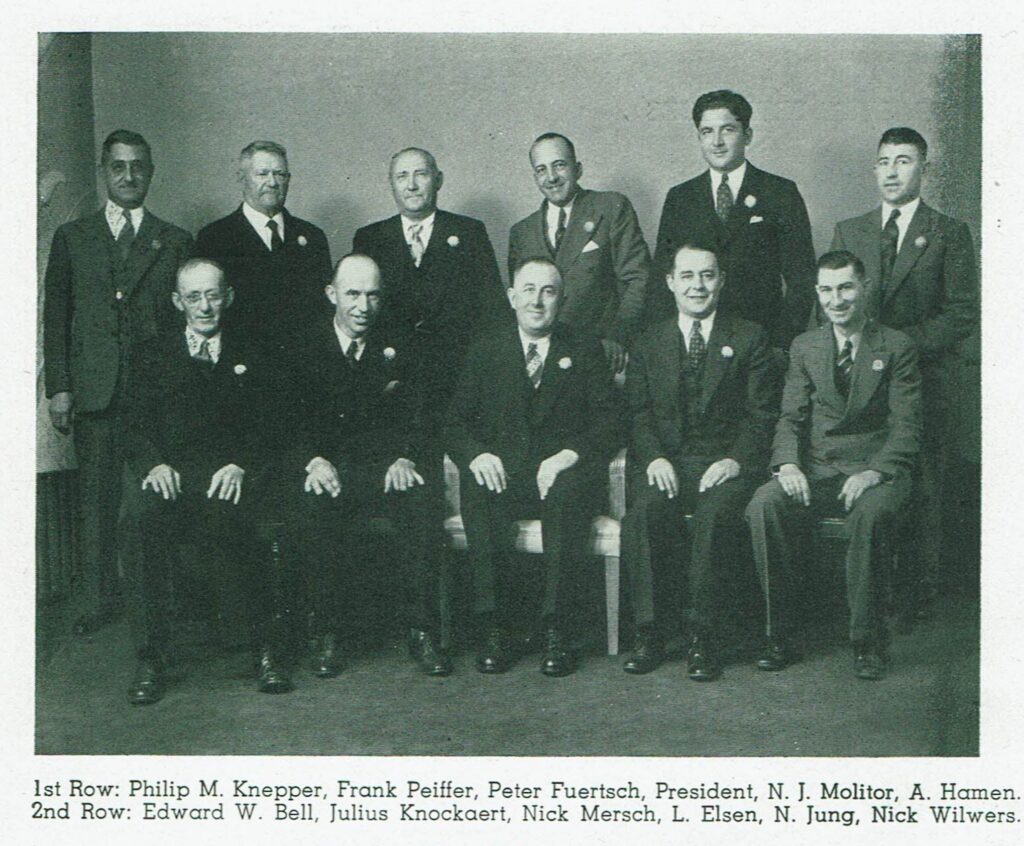
Section No. 8 – Evanston, Illinois
Section No. 8 was organized on February 23rd, 1902, in the City of Evanston. 43 Charter members were initiated by the Grand Officers, with John N. Watry presiding. The organizers of this new Section were Nick Gans and Hubert Hoscheid. The Charter Members were:
| Hubert Hoscheid | Adolph Reding | John N. Weiland | N. K. Welter |
| Michael Weiland | Frank Linster | Henry C. Geimer | Frank Welter |
| Peter Miller | Peter Bieffrich | Nick Williams | John P. Remich |
| Nick Steffen | Andrew Reisch | Henry Schmit | Michael Hirtzig |
| John Fischbach | John P. Wanderscheid | Mathias Watgen | Paul Sterpenig |
| Henry Olsen | Nick Fischbach | Martin Schmitz | Nick Majerus |
| Nick Gans | Peter Schimberg | Michael Reding | J. P. Damit |
| John Becker | John May | Michael Schumer | Lorenz Elsen |
| Frank Elsen | Andrew Theisen | Nick Olinger | William Pestka |
| Mathias M. Miller | Martin Mersch | Nick Brosius | Frank Leider |
| Michael Louis | Frank Miller | Frank Shelsky | Steven Marso |
| Nick Olinger | Peter Didier | George Guirsch |
John P. Sterpenig, honorary member.
The first set of officers elected were:
| President | Hubert Hoscheid |
| Vice-President | John P. Remich |
| Recording Secretary | Henry Geimer |
| Finance Secretary | Nick Gans |
| Treasurer | John Weiland |
| Trustees | Michael Schumer, N. K. Welter, Peter Schimberg |
| Marshal | Mathias M. Miller |
| Grand Representative | Nick Gans |
Section No. 8 has been very progressive, from the time of its foundation up to the present. It has gained a fine reputation with its annual picnics, held from 1902 until 1929. After this the picnic was changed to a “Kirmess”. This festival has become most popular in recent years. Besides the “Kirmess”, the Section sponsors several other festivals,—a St. Patrick’s Party, Halloween Party and May Festival.
The destinies of the Section were guided by the following Presidents:
| Hubert Hoscheid | John P. Remich | M. Weiland | Nick Steffen (Died 1938) |
| John May | Jacob Schaak | John Schaul | Charles K. Schmind |
| Peter Fuertsch |
Section No. 8 has been very generous in its donations and its assistance to deserving brothers in need. It has given as well to other charitable enterprises of St. Nicholas Parish in Evanston and lent its aid to civic enterprises of the City of Evanston. Among the members of the Section, the following served in the World War:
| Fred Brosius | Nick Brosius | Lawrence Elsen | Peter Erpelding |
| Jos. Fischback | Math. Guirsch | Frank Gerend | Theo. Hames |
| Peter Knockaert | Peter Linster, Sr. | Peter Linster | Wm. Leider |
| Nick Mersch | Ernest Mersch | Peter May | Michael Olk |
| Emil Reding | Jos. Schumer | Frank Schroeder | George Schumer |
| Wm. Schreiner | Math. Steffen | Leo Schimberg | Anton Schwind |
| Emil Urhausen | Math. N. Welter | Nick Wilwers | Frank Weiler |
| Wm. Wiltgen |
The present officers are (1938):
| President | Peter Fuertsch |
| Vice-President | Frank Pfeifer |
| Rec. Secretary | Nickolas Molitor |
| Fin. Secretary | Philip M. Knepper |
| Treasurer | A. Hamen |
| Trustees | Jules Knockaert, Nick Mersch and Edward W. Bell |
| Marshal | Nick Jung |
| Asst. Marshal | Nick Wilwers |
| Examining Physician | Dr. H. W. Luessman |
Section No. 9 – Lake View, Chicago
Section No. 9 was founded in the Lake View District of Chicago in Schmitz Hall on Lincoln Ave. and Roscoe St. on March 2nd, 1902.
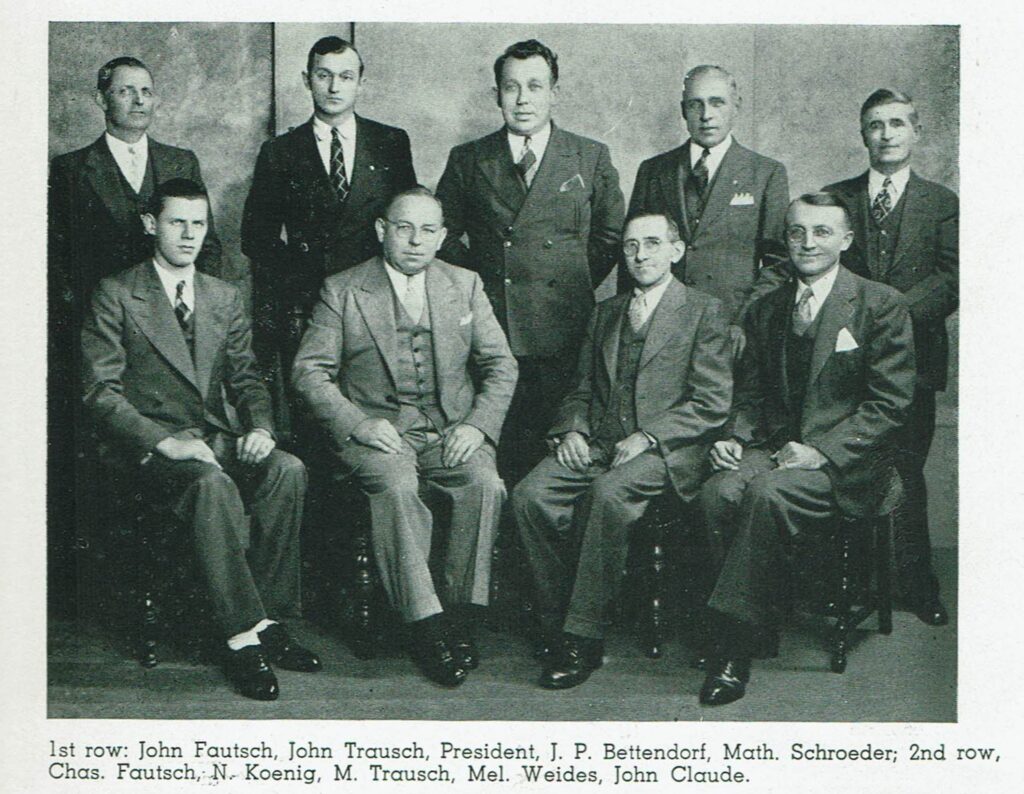
The following were the charter members:
| Michael Mueller | Michael M. Welter | J.P. Zeigele | J. P. Bettendorf |
| N. Grandjean | P. S. Schmitz | J. P. Origer | John Brunsfeld |
| Henry Hansen | N. Origer | John Eiffes | Andrew Welter |
| John C. Thill | John Kohn | Peter Olinger | Bernard Knepper |
| Frank Biewer | Peter Schoos | N. Faber | N. Majerus |
| J. Schoeder | M. Theis | P. Weber | P. Mueller |
| J. Dattelzweig |
The 1st regular meeting was held on March 16th, at which time the charter members were initiated and the new officers installed by the Grand Officers of the Brotherhood. Three charter members are still members of the Section, J. Kohn, J. Eiffes and B. Knepper.
The 1st set of officers were:
| President | Michael Mueller |
| Vice President | Michael M. Welter |
| Rec. Secretary | Louis Ziegele |
| Fin. Secretary | J. P. Bettendorf |
| Treasurer | P. Schmitz |
| Marshal | J. P. Origer |
| Trustees | John Brunsteld, Michael Theis and Henry Hansen |
The social activities of Section No. 9 have been very popular. Before the war their Annual Sylvester Masquerade Ball was an opportunity for the Luxembourgers to celebrate the arrival of each New Year. In later years the Section has arranged a winter festival, which has become very popular with the members of all Sections and especially with the younger people. These activities not only benefited the Section’s finances but also increased its prestige as a progressive and active Section.
Several of the members of Section No. 9 have been honored with Offices in the Grand Lodge. Henry Dieschbourg was for a great number of years Grand Vice-President and was appointed Grand President at the death of Henry C. Geimer. Henry Dieschbourg held this office until the time of his death a few years later. Michael Welter and Albert Wants held the office of Grand Trustees for a number of years and both of them distinguished themselves for their faithful services.
John Schroeder the former editor of the Luxembourger Vereinszeitung was Vice President and Secretary for several years. J. P. Bettendorf was Financial Secretary for 20 years and at the present time holds the office of Vice President. Math. Schroeder has been Financial Secretary since 1921, while the Marshal of the Section, John Claude will be able to celebrate his Silver Jubilee after the present term of office. Michael Wernimont was Treasurer for over 25 years and would still be in office, had not illness prevented him from accepting further duties.
It may be mentioned here that the three Trausch Brothers John, Harry and Michael have been most active in the services of Section No. 9. John has held the office of President for a great number of years; he is a leader and a diplomat, with a pleasing personality, and has become very popular in the Luxembourg Colony of Cook County. He is at the present time also Commander of North Town Post of the American Legion. Harry Trausch was Recording Secretary for many years while Michael Trausch served with distinction as Trustee. Besides the three Trausch brothers, the following additional members served in the World War:
| Michael Wernimont | Victor Wernimont | Alex Kremer | James Arendt |
| John Linster | Nickolas Weber | Bernard Majerus |
The following members have served as Presidents:
| Michael Muller | Michael M. Welter | Peter Schumacher | M. B. Wernimont |
| Nick Granjean | Albert Wantz | Math. Schroeder | John Trausch |
All these men were imbued with the true spirit of Luxembourg Fraternity, and it is largely due to their efforts that the Section has attained such an excellent record.
Section No. 11, Granville, Iowa
Section No. 11 was organized by John Ries, a former member of Section No. 1, with the assistance of George Wagner and Dominick Berg. The Section gathered for the first time on June 7th, 1903, with the following charter members present:
| George Wagner | Frank Goergen | Dominick Berg | John Eulberg |
| Nick Graff | Nick Bertemes | William Faber | Herman Schwartz |
| Nick Block | Bernard Berg | H. Schemmel | John Corat |
| Mathias Malget | N. J. Klassen | N. H. Krips | Peter Wieldschuetz |
| Nick Weis | Peter Hemmer | Peter Mergen | J. H. Remacle |
| M. Remacle | A. Winkel | Math. Fisch | Joseph Schumacher |
| Nick Schwebach |
The last three named are still active.
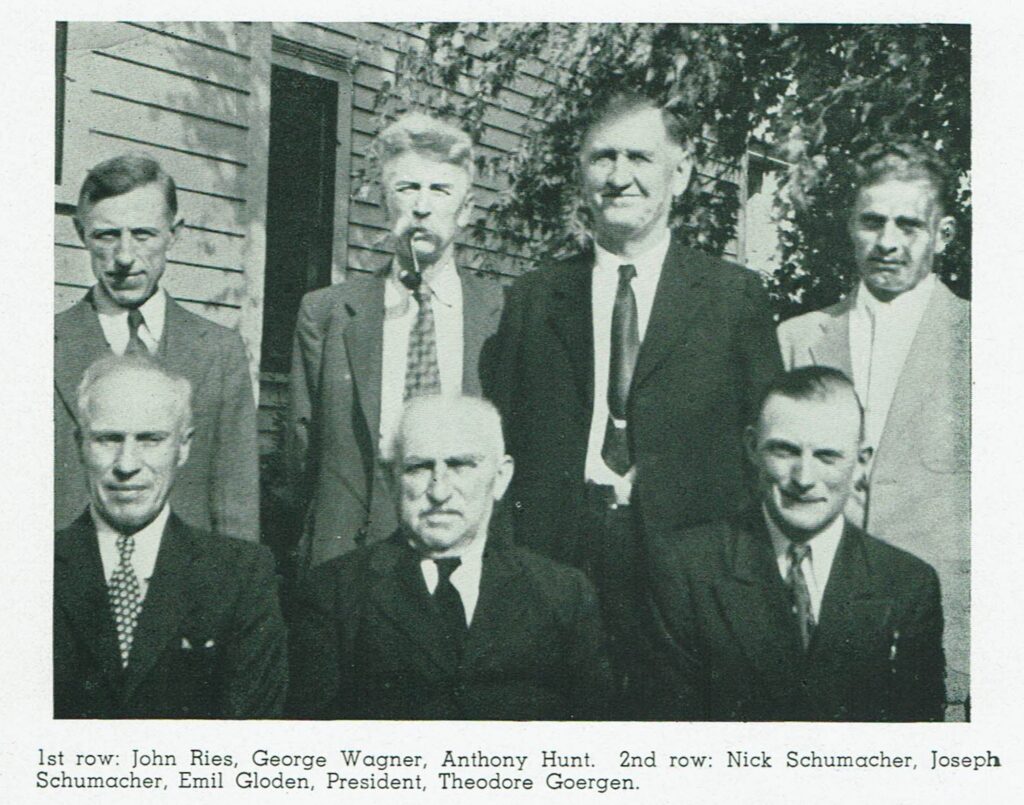
The first officers elected were
| President | Dominick Berg |
| Vice President | John Eulberg |
| Secretary | George Wagner |
| Fin. Secretary | Frank Goergen |
| Treasurer | N. H. Graff |
| Marshal | Nick Block |
| Trustees | Nick Bertemes, William Faber and Herman Schwartz |
Section No. 11 was never to spread out much; its activities were limited because of the few Luxembourgers living in Granville and the immediate vicinity. Its loyalty and faithfulness to the Grand Lodge, however, and its benevolent spirit towards its members and their families made Section No. 11 a recognized part of the social life of the Remsen country district.
The following members served in the office of president:
| Dominick Berg | William Faber | John H. Remacle | Nick Ahles |
| Emil Gloden |
One of the outstanding members of Section No. 11 is John Ries, who organized the new group after he had moved from Chicago to Granville. He is a renowned singer and musician, having assisted in the organization of the Luxembourger Saengerbund. He has been the leader of the Granville Band for the past 20 years. He has served as Grand Representative to the Grand Lodge for many years and seldom misses a convention, although Granville is nearly 400 miles from Chicago. The present president, Emil Gloden has been in office for 16 years, always serving the Section to the best of his ability.
The following officers of the Section at the present time:
| President | Emil Gloden |
| Vice-President | John Ries |
| Secretary | Theodore Goergen |
| Treasurer | Jos. Schumacher |
| Marshal | Anton Hunt |
| Trustees | Nick Schumacher, N. T. Schwebach and Joseph Neuroth |
Section No. 13 – Milwaukee, Wisconsin
Section No. 13 was organized in December 1904, by Henry Dieschbourg, the Grand Representative of Section No. 1. The following charter members were present:
| Theodore Arend | Nick Anzia | J. Walter | Nick Zeimet |
| Joseph Lippert | John Bohler | Bernard Menge | Nick Mueller |
| John Pierre | Dom. Thill | John Wiltzius | John Wagner |
| Thomas Biever | Peter Mangen | J. N. Pierre |
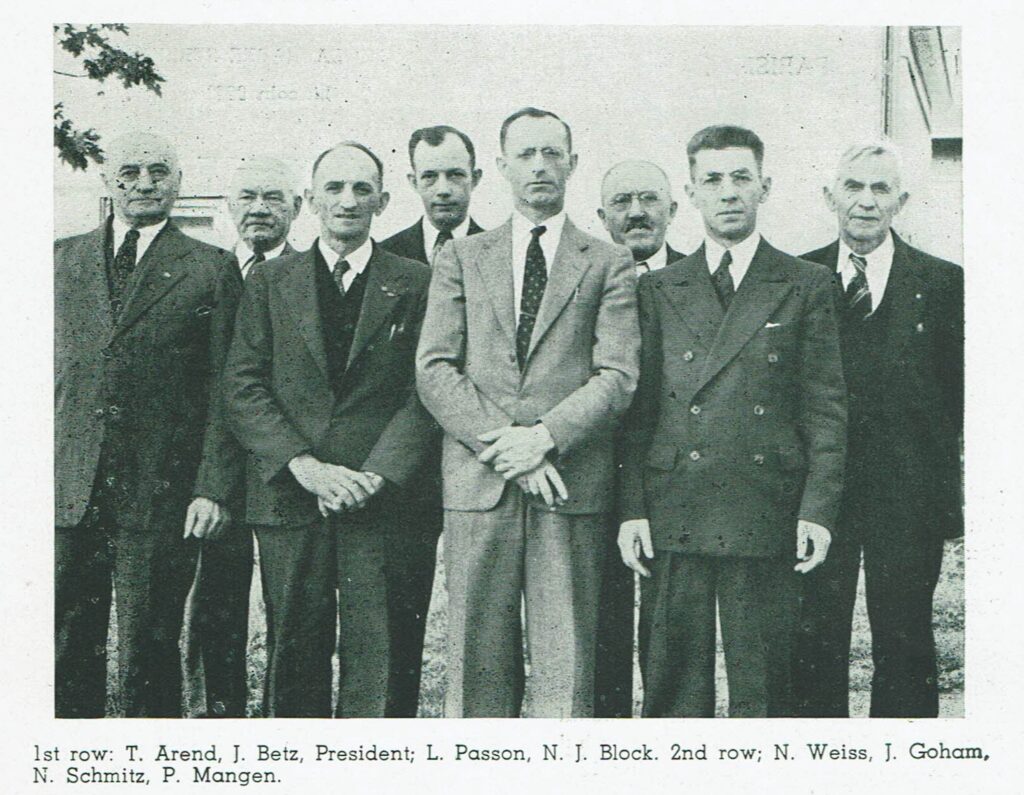
The first set of officers elected were:
| President | John Bohler |
| Vice President | Thomas Biever |
| Rec. Secretary | Theo. Arend |
| Fin. Secretary | John Wiltzius |
| Treasurer | Nick Mueller |
| Marshal | John Pierre |
| Examining Physician | Dr. D. P. Thill |
Theodore Arend is the only living charter member of the Section and in all these long years he has been very active, holding many offices. All meetings at the present time are held at his place of business, which is known as the “Luxembourger Headquarters,” on Green Bay Road in Milwaukee, Wisc.
Dr. D. P. Thill, another one of the charter members was very well-known in the Section, serving for many years as Treasurer. He was recognized for his conservatism and through his efforts the Section was always in good financial standing.
John Betz, the present President of Section No. 13, is a diligent worker and has always given his very best to guide the destinies of the Section. He has been employed for 20 years in the Sacred Heart Sanitarium in Milwaukee, where he enjoys the respect and esteem of the sisters.
Section 13 has been most generous in dispensing relief and assistance to needy brothers and other Luxembourgers in Milwaukee. Their social functions are very popular with Luxembourgers and with people of other nationalities in Milwaukee as well, and are always well attended.
The present officers are (1938):
| President | John Betz |
| Vice President | Louis Passon |
| Secretary-Treasurer | N. J. Block |
| Fin. Secretary | Theodore Arendt |
| Marshal | Joseph Goham |
Section No. 14 – Remsen, Iowa
Section No. 14 of the Luxembourg Brotherhood of America was organized on May 14th, 1905, through the energetic efforts of J. P. Kieffer and Michael Treinen. The charter members of the Section were:
| J. P. Kieffer | Peter Hames | Michael Treinen | John Kieffer |
| Leonard Meyers | J. P. Beck | Cornelius Wollwert | Henry Koob |
| William Heidesch | Theodore Koob | I. P. Steffen | Charles Flamming |
| Michael Bruecher | Michael Lanners | Theodore Freders | Michael Lamberto |
| John Zigrang | Henry Kemp | Peter Hoursch | Michael Britz |
| Michael Klein | Frank Bartels | John Janty | Nickolas Aust |
| Peter Clements | J. W. Galles | J. P. Bruecher |
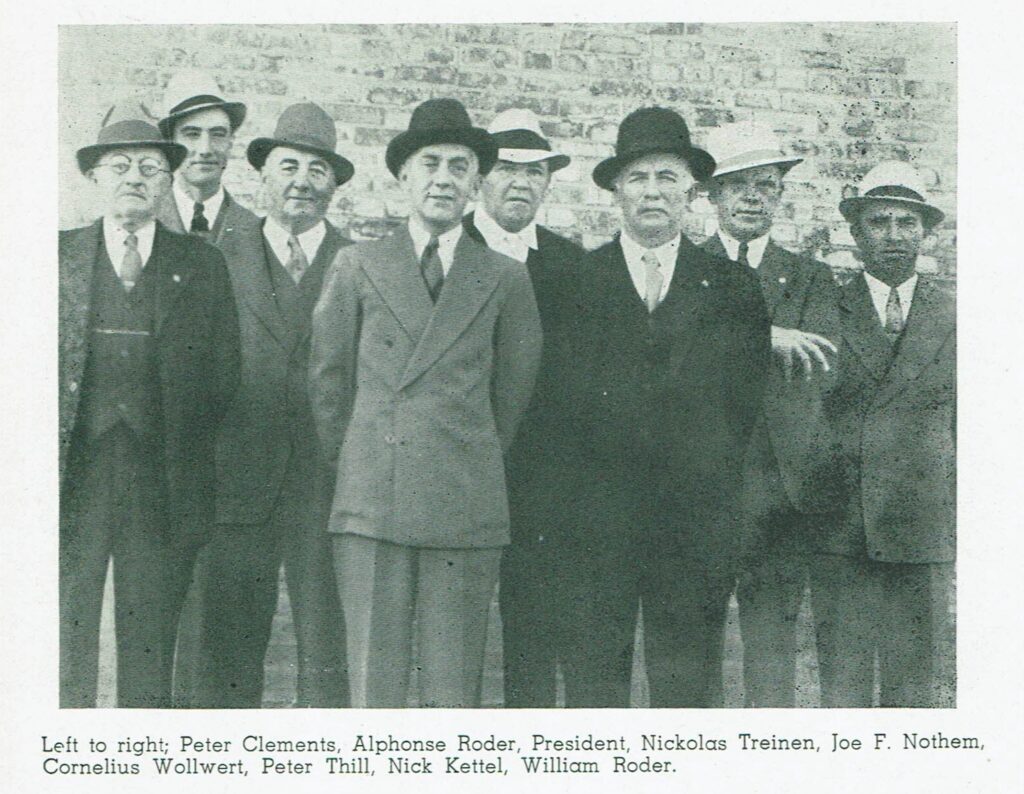
The following temporary officers were elected at this meeting:
| President | J. P. Kieffer |
| Vice President | J. P. Bruecher |
| Secretary | Henry Koob |
| Treasurer | Michael Treinen |
After 4 months the following set of officers were installed:
| President | J. P. Bruecher |
| Vice-President | Henry Koob |
| Rec. Secretary | J. P. Kieffer |
| Fin. Secretary | Peter Hames |
| Treasurer | Michael Treinen |
| Marshal | William Heidesch |
| Ass’t. Marshal | Cornelius Wollwert |
No. 14 was always a very good Section; it conducted its meetings in a business-like manner and followed strictly the rules and regulations of the Grand Lodge. It was imbued with the true spirit of Luxembourger Fraternalism and under the leadership of Michael Treinen it made fine progress. Its festivals and picnics attracted the whole countryside around Remsen.
At the last picnic held on August 21st, 1938, Section No. 14 had the pleasure of playing host to the Grand President, the Hon. Fred A. Gilson and the Luxembourg Vice Consul, the Hon. Wm. Capesius. Both men delivered an address of interest to the Luxembourger people, and both were warmly received by the visitors at the picnic.
The following members were at one time or another presidents of the Section:
| J. P. Buecher | Peter Clements | Nick Thill | Anton Hames |
| Michael Treinen | Frank Bulner | Michael Bruecher | Alphonse Roder |
The present officers are (1938):
| President | Alphonse Roder |
| Vice-President | William Roder |
| Secretary | Jos. F. Nothum |
| Treasurer | Martin Kettel |
| Marshal | Peter Clements |
| Trustees | Nick Treinen, Peter Thill and Corelius Wolwert |
The membership at the present time (1938) totals 39.
Section No. 15, Niles Center, Ill.
Section No. 15 was organized by Joseph Hohs in July 1905, Grand President Math. J. Huss and Grand Secretary Nickolas Nilles were the Installing officers. The Charter members were:
| Henry Hermes | Michael Conrad | Anton Doetsch | Michael Hermes |
| August Luettig | Gustav Frisch | Joseph Hohs | John P. Schaul |
| Nickolas Hermes | Nickolas Schaefer | John N. Wagner | Peter Puetz |
| George Buscher | Joseph Puetz | Peter B. Dahm | William Hensel |
| Michael Leider | Frank Hoveley | Peter Hohs | J. P. Wagner |
| John Kalmes | Anton Krier, Sr. | Fred Schoening |
The last three named are still living as of 1938.
The first set of officers selected were:
| President | Joseph Hohs |
| Vice-President | Michael Leider |
| Rec. Secretary | John Kalmes |
| Fin. Secretary | Peter Hohs |
| Treasurer | John P. Schaul |
| Trustees | Anton Krier, Sr., Michael Hermes and Frank Hoveley |
| Marshal | Peter Puetz |
Section 15 has been very active and its record as a benevolent society is very good; it always has taken care of sick and needy members, it has given solace and a word of cheer to unfortunate members and assisted all those in distress. The social functions of the Sections are always well attended, and their financial success is always assured.
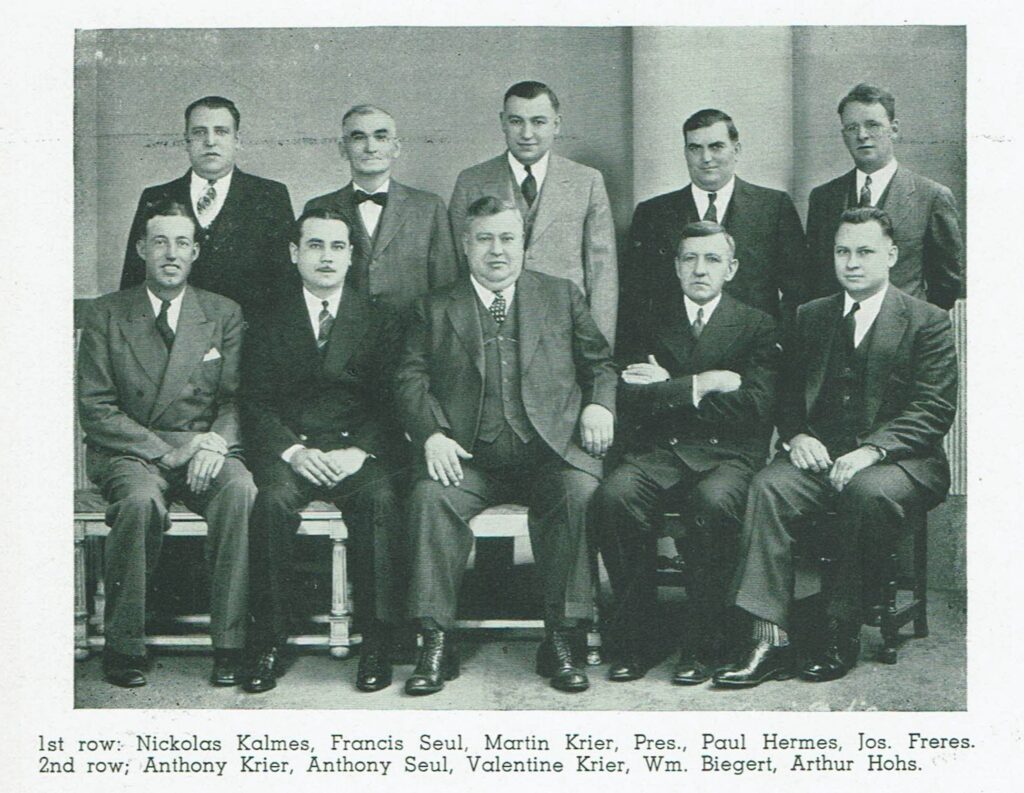
The following members served as presidents during the existence of the Section:
| Joseph Hohs | Michael Hermes | Ben. Schaul |
| Michael Leider | Anton Krier, Sr. | Martin Krier |
On the death roll we find the following members:
| George Buscher | Dominick Klein | Peter Dechambre | Joseph Lanners |
| Joseph Haupt | Peter A. Lanners | Henry Hermes | Michael Leider |
| Michael Hermes | Jacob Roemer | Nickolas Hermes | William Wagner |
| Peter Hohs | Henry Vogt |
The present (1938) officers of the Section are:
| President | Martin Krier |
| Vice-President | Francis Seul |
| Rec. Secretary | Paul Hermes |
| Fin. Secretary | Nick Kalmes |
| Treasurer | Joseph Freres |
| Trustees | Anthony Seul, Valentine Krier and William Biegert |
| Marshal | Anton Krier, Jr. |
| Ass’t. Marshal | Adam Hohs |
| Grand Representative | Anthony Seul |
Section No. 17 – West Side, Chicago
On July 9th, 1905, John Diederich organized Section No. 17. The Installation officers were Grand President John N. Watry and Grand Secretary Nickolas Nilles. The charter members of the Section were:
| John Mangen | Wm. Goedert | John P. Wilwers | Frank Pepping |
| Jacob Karels | Henry Magonette | Conrad Schmitt | John P. Schaus |
| Nick Wiard | Nickolas Spang | John Mergen | John Trausch |
| Paul Spang | John Kinsch | Chas. Binsfeld | Geo. Schaack |
| Arnold Schomer | John Scherer | Peter Wilhelm | Nick Goettert |
| John Schmit | Mathias Meier | Peter L. Hoffman | Math. Shanan |
| Nick Hansen | Nick Spang | Math. Hansen |
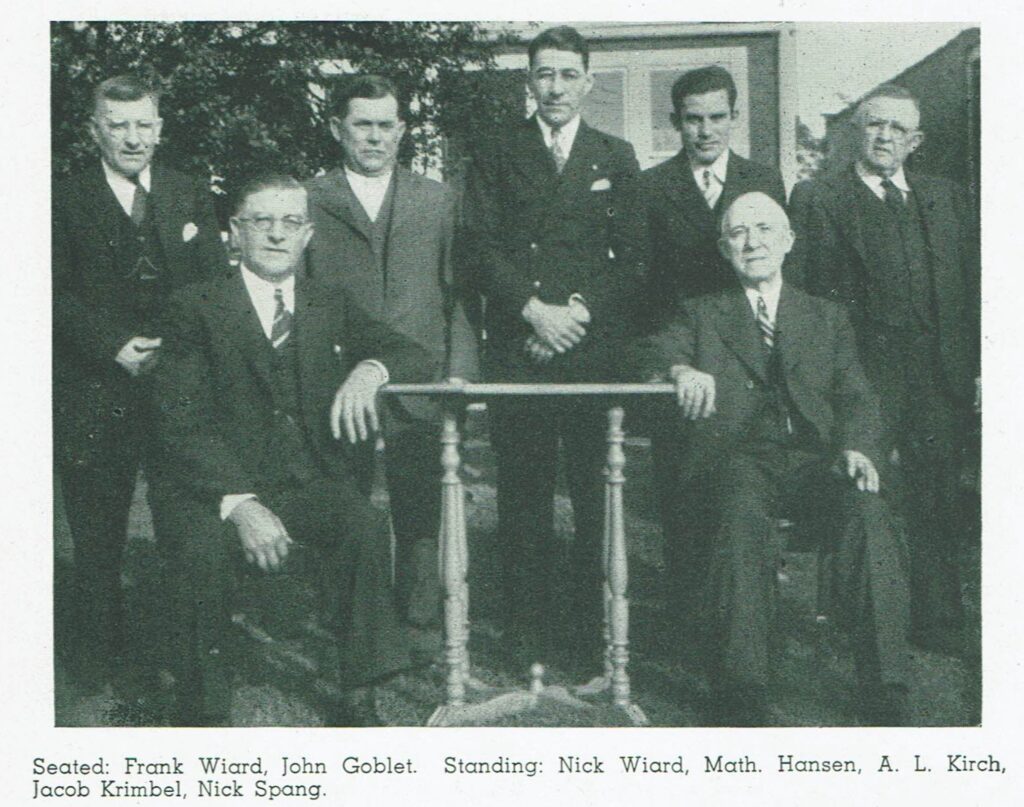
The 1st set of officers were:
| President | John Mangen |
| Vice-President | John P. Wilwers |
| Recording Secretary | William Goedert |
| Financial Secretary | Nick Wiard |
| Treasurer | Frank Pepping |
| Trustees | Nick Spang, John Mergen and Clemens Schoos |
| Marshal | Jacob Karels |
At the time that Section No. 17 was organized on the Southwest side, there were many Luxembourgers living in that vicinity. In later years, most of them moved out to other neighborhoods and consequently the Section lost many members. At the present time the membership is just 24, but those that still remain, are imbued with the courage to support the Section to the very end.
Some of the members of Section 17 were honored with an office in the Grand Lodge; John Mangen was Grand President, Peter L. Hoffman was Grand Trustee and John Kinch was Grand Marshal for many years. One of its members, Michael Zimmer, was Sheriff of Cook County and for many years Warden at the Cook County Hospital.
In 1912 the Grand Lodge convention was held under the auspices Section No. 17. This was a very colorful affair, starting on Sunday with a large parade, bands and entertainment and finishing on Monday with the business session.
The present officers are:
| President | Nick Wiard |
| Vice-President | John Goblet |
| Rec. & Fin. Secretary | Mathias Hansen |
| Treasurer | A. L. Kirch |
| Trustees | Frank Wiard, John Goblet and Jacob Krimbel |
Section No. 21, Wilmette, Ill.
Section No. 21 was organized on May 12th, 1909, through the efforts of Philip Doetsch, Joseph Eischen, Math. Hoffmann and Peter Sesterhenn. Grand President Mathias Huss installed the new officers and initiated the 43 Charter members, who were:
| Philip Doetsch | Math. Hoffmann | Paul Hermes | Joseph Eischen |
| Peter Sesterhenn | Michael Loutsch | John Hoffmann | Bernard Doetsch |
| Anton Puetz | Peter J. Koerper | Frank Hoveley | Wm. Rengel |
| John Sesterhenn | John Loutsch | Wm. Kriesart | Jos. Heinzen |
| Max Engels | J. B. Lambert | Peter Louis | Gustav Frinck |
| John Epp | Math. Barnig | Joseph Puetz | Peter Kirchens |
| Chas. Braun | Joseph Rengel | Gustav Eischen | Joseph Pettinger |
| George Reding | Martin Meier | W. B. Thalman | Joseph Steffen |
| Jacob Reinwald | J. B. Dalecke | Anton Reinwald | Frank Evert |
| Bernard Hens | Emil Rome | John Reding | John Ludovice |
| Jacob Roemer | John Neis |
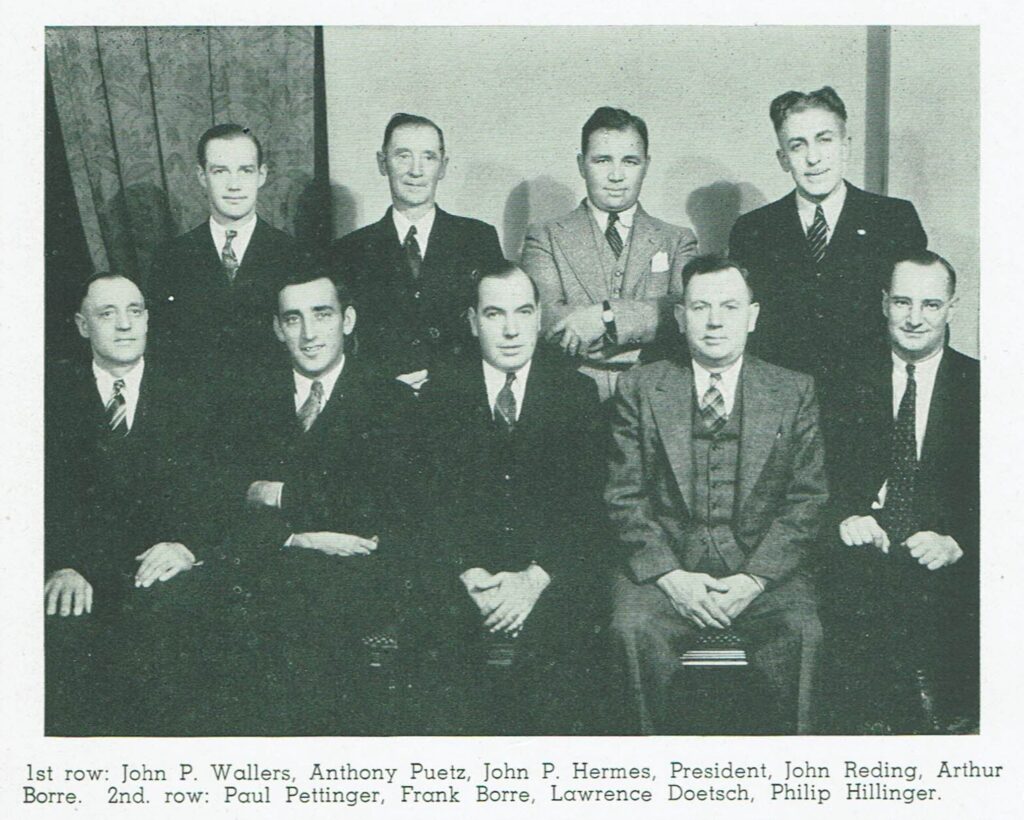
At the 1st meeting the following officers were elected:
| President | Phillip Doetsch |
| Vice-President | Math. Hoffmann |
| Rec. Secretary | Paul Hermes |
| Fin. Secretary | Joseph Eischen |
| Treasurer | Peter Sesterhenn |
| Trustees | Anton Puetz, J. B. Lambert and Michael Loutsch |
Section No. 21 was very progressive from the start, it was very considerate in the selection of new members, remained deeply interested in the welfare of its members and consequently its growth was steady and continuous. The social functions of the Section were of the old fashioned type wholesome and always well attended. An Annual Thanksgiving Dance and an Easter Masquerade Ball were the high spots of its Social Calendar.
The society was guided by the following Presidents:
| Phillip Doetsch | Adam Barnig | Michael Loutsch | Anton Puetz |
| Joseph Eischen | George Reding | William Pettinger | Paul Hermes |
All of these men were endowed with the fine qualities of leadership, and all of them left a spirit of good will among the members. Michael Loutsch, who served for 14 years, did much in bringing the financial standing of the Section to a sound and secure basis. Anton Puetz, who guided the destinies of the Section for 8 years did much in increasing the membership and brought the Section up to its greatest strength.
Math. Hoffmann, who was treasurer of the Section for 17 years, also was honored by the Grand Lodge with the office of Grand Vice-President, which he has held for the past 8 years.
It is especially noteworthy that Section No. 21 had 25 members in the World War service, which number was about ½ of its total membership. This fact will serve, too, as an indication of the youth of its membership.
The present officers are (1938):
| President | John P. Hermes |
| Vice-President | Anton Puetz |
| Rec. Secretary | Arthur Borre |
| Fin. Secretary | John Reding |
| Treasurer | J. P. Wallers |
| Trustees | Lawrence Doetsch, Phillip Hillinger and Frank Borre |
| Marshal | Paul Pettinger |
| Ass’t. Marshal | Roman Rengel |
Section No. 25 – Lincolnwood, Ill.
Section No. 25 is located in Lincolnwood (formerly Tessville); a suburb about 6 miles from the Chicago City limits. It was organized on March 12th, 1911, by the following members:
| Leopold Bree | William Becker | Michael Weber | Cornelius, Kellen |
| Nick Herff | John Origer |
The Grand Officers, led by Eugene Huss, initiated and installed the new officers in the presence of 19 charter members. The charter members were:
| Leopold Bree | William Becker | Michael Weber | Cornelius Kellen |
| Nick Herff | John Origer | Frank Tess | Nicholas Grotz |
| Joseph Simon | Nicholas Origer | Fred Maierhofer | Frank Becker, Sr. |
| John E. Esch | Charles Tess | John P. Ziegle | John Schultz |
| Oscar Proesel | John Meier | Math. Freres | Mike Demuth |
| Michael Kaufman | Emil C. Blameuser |
The first officers elected were:
| President | Cornelius Kellen |
| Vice-President | Leopold Bree |
| Recording Secretary | William Becker |
| Fin. Secretary | Nickolas Grotz |
| Treasurer | Michael Weber |
| Marshal | Michael Kaufman |
| Trustees | Joseph Simon, Nickolas Herff and John C. Meier |
| Physician | Dr. R.V. Sintzel |
LUXEMBOURG YOUTH ORGANIZATION
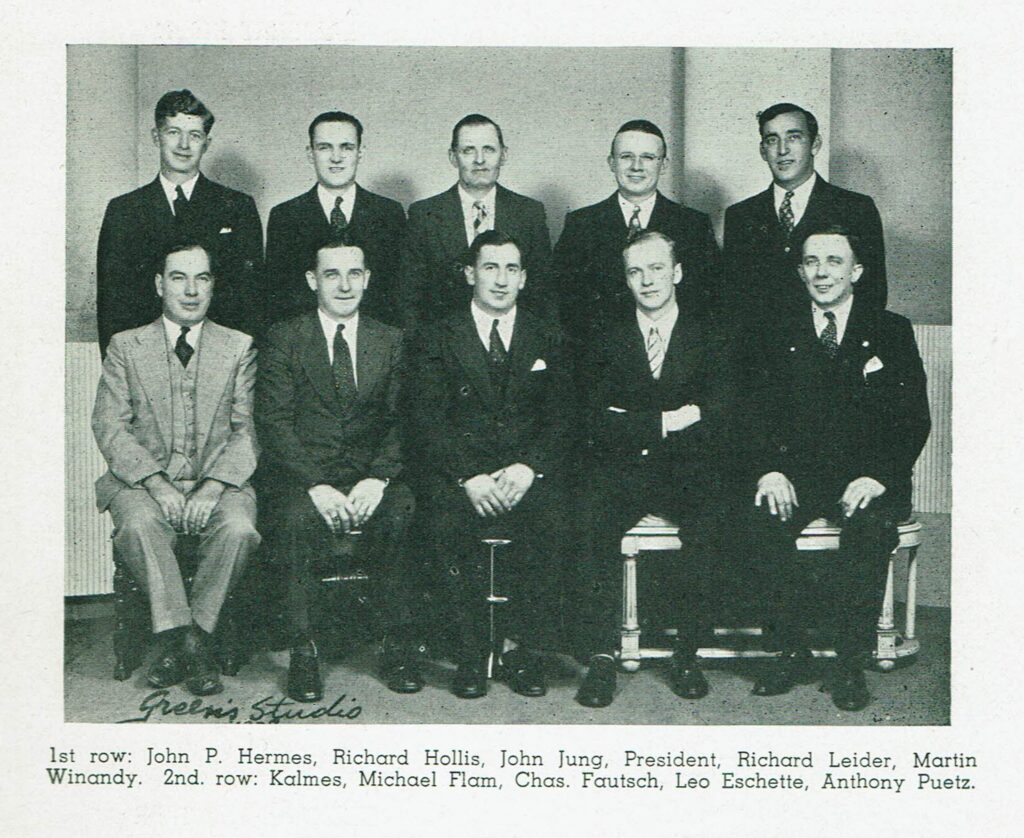
The Luxembourg Youth Organization was established in the spring of the year 1937, under the direction of the Grand President, Fred A. Gilson. The purpose of the organization is to promote sport athletics, socials, and other features interesting the younger members of the Luxembourg Brotherhood.
The Luxembourg Youth Organization is the Central organization of the Luxembourg Youth groups of the various Sections. These various youth groups make up teams of competitive sport and play each other for the championship of the Brotherhood.
The Officers of the Luxembourg Youth Organization are:
| President | John Jung |
| Vice-President | Richard Hollis |
| Secretary | Richard Leider |
| Treasurer | John Hermes |
| Trustees | Michael Flam, Leo Eschette and Chas Foutsch |
| Marshal | Tony Puetz |
| Ass’t. Marshal | Jacob Kalmes |
| Publicity Mgr. | Martin Winandy |
The Golden Jubilee – 1888 – 1938
A Pictorial and Historical Souvenir Program Book
Celebration of the Luxembourg Brotherhood of America
Compiled by Fred A. Gilson, Sunday, November 27th, 1938
Swiss Club House 635-639 Webster Ave. Chicago, IL.
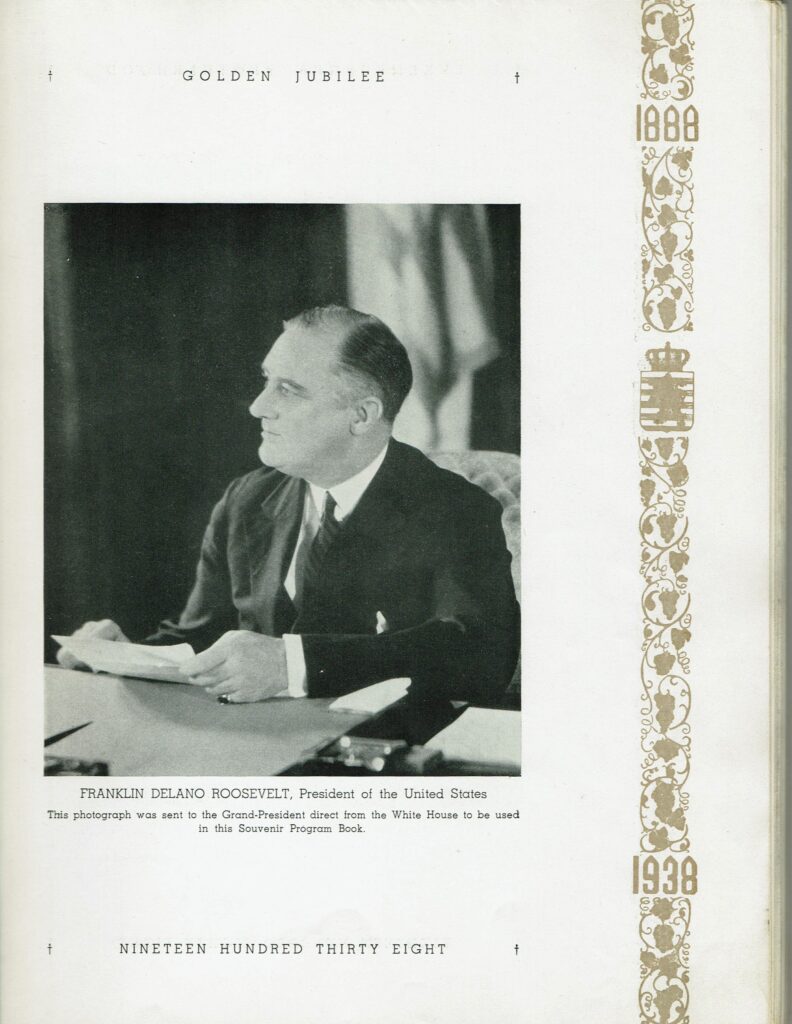
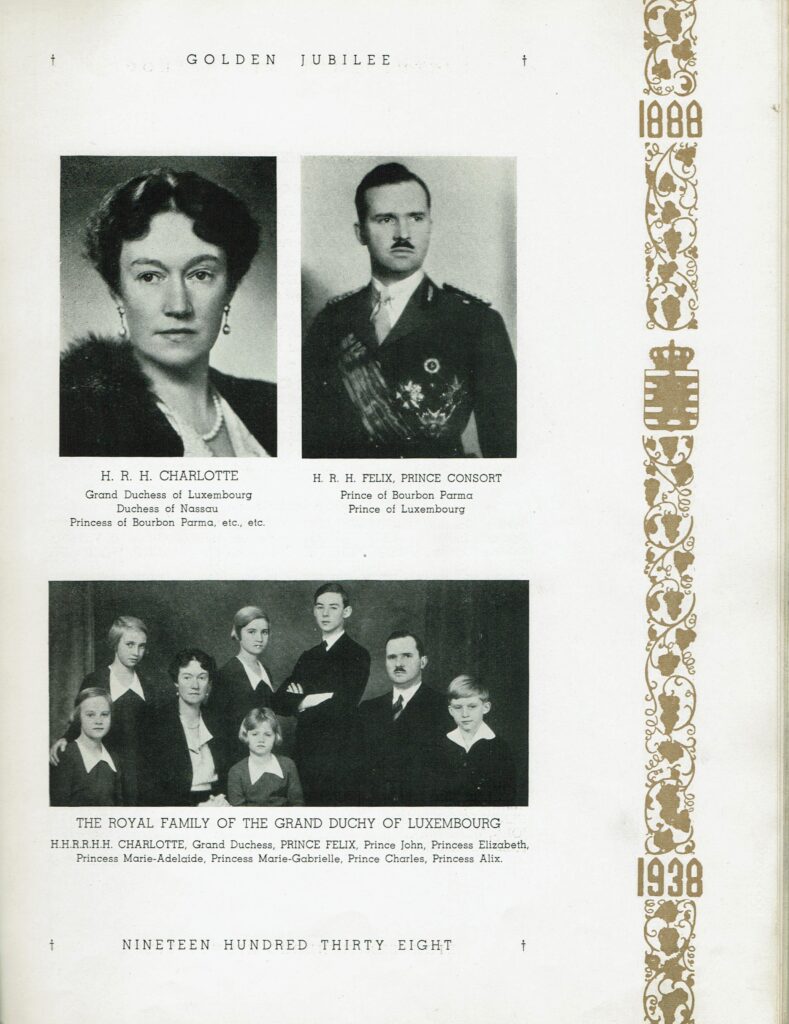
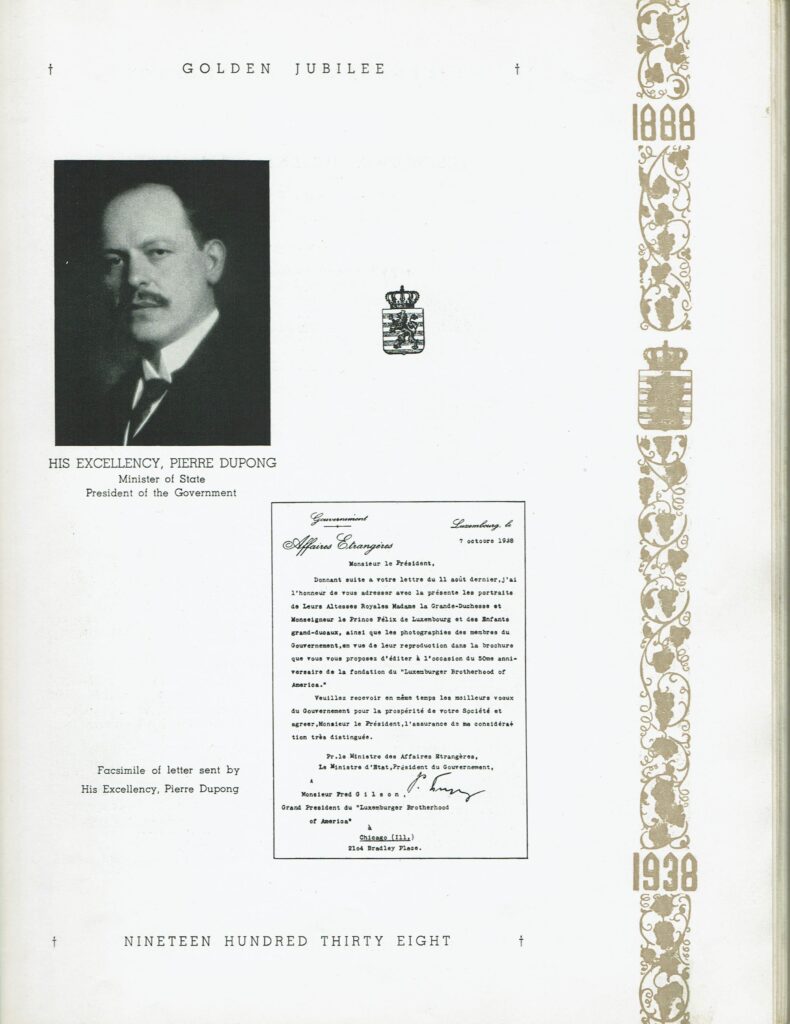
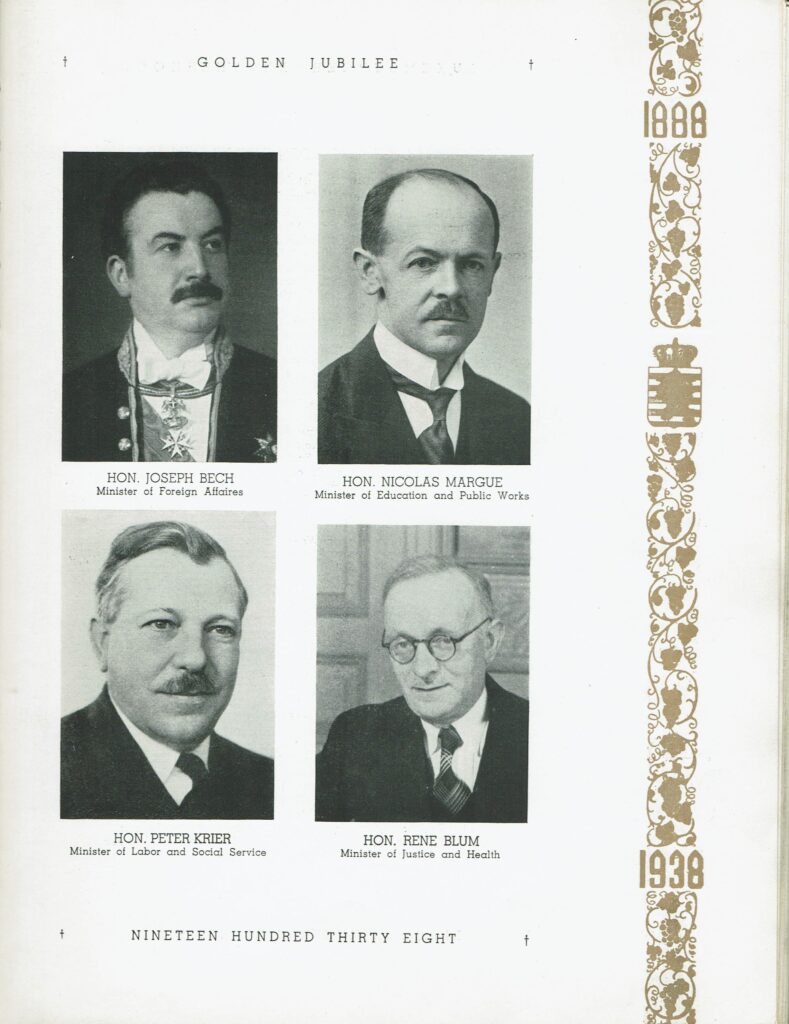
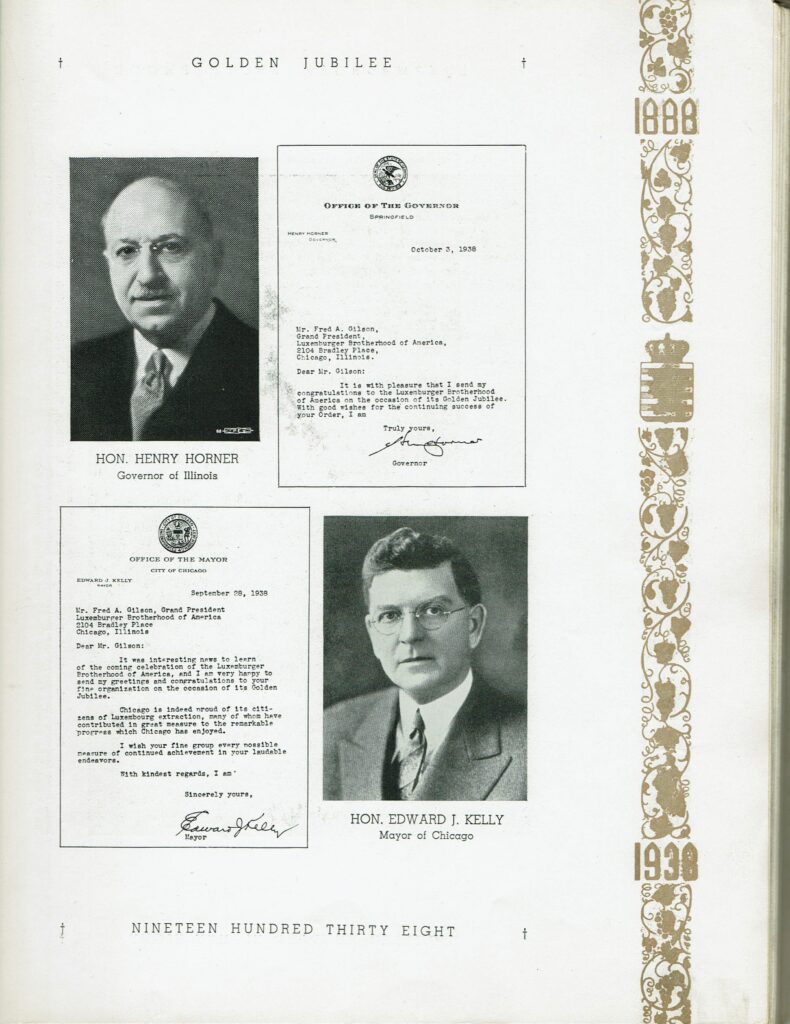
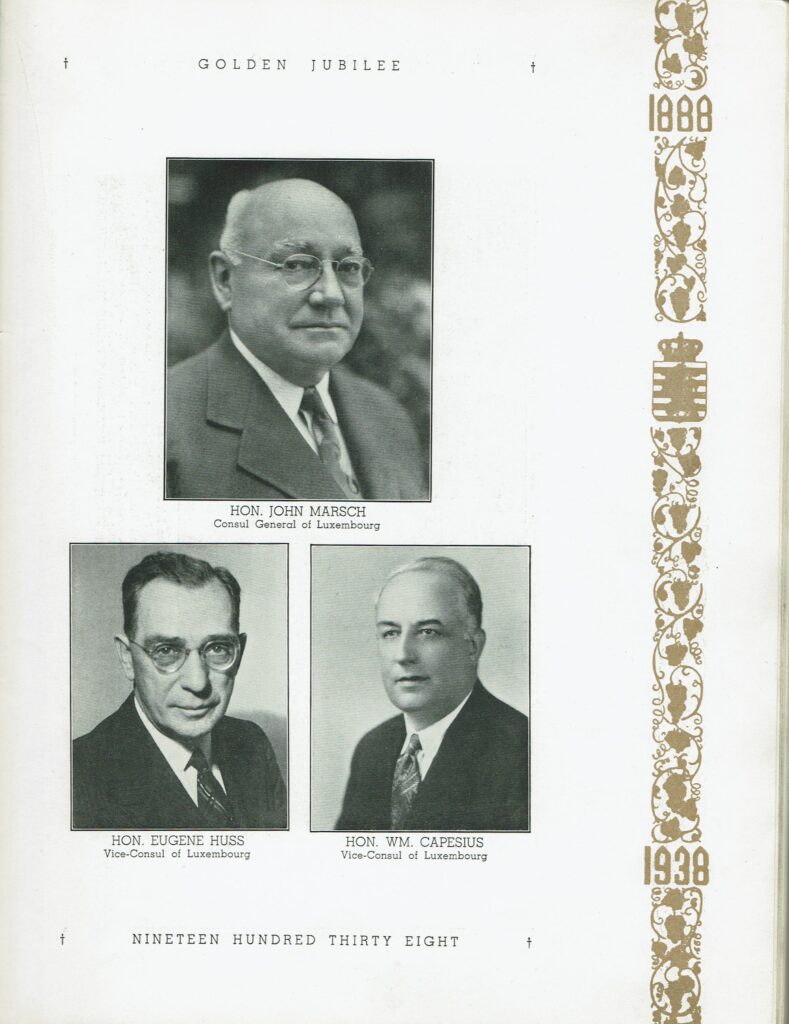
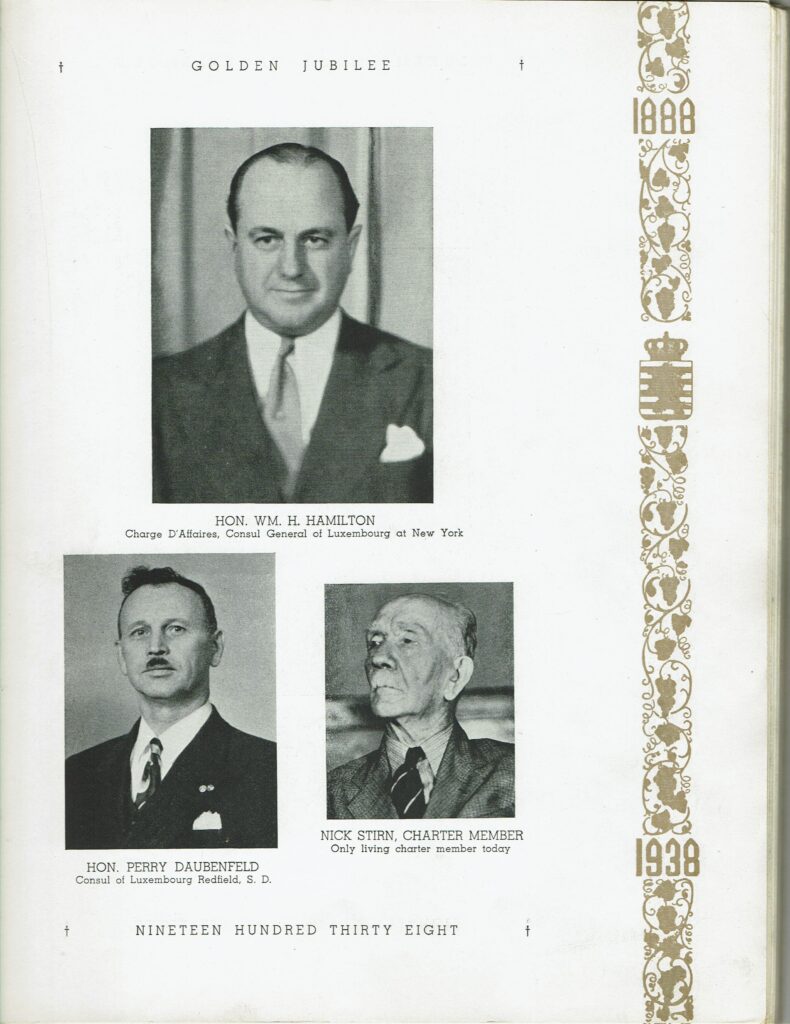
Recent Comments